














Chichén Itzá
Archeological site
Chichén Itzá
Patrimonio mundial
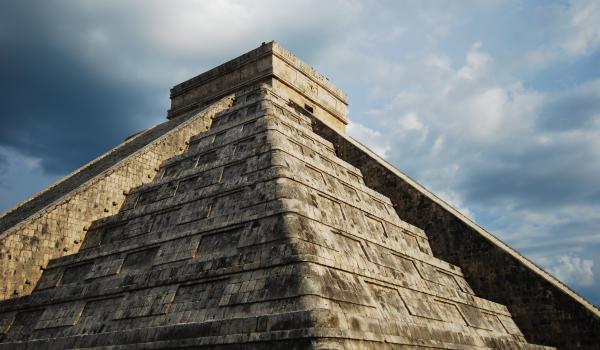
At the time of the equinoxes, the shadow of Kukulkan, the serpent, descends from its temple to fertilize the earth, while the red jaguar is hidden in the Temple of the Warriors, with its jade spots glowing. This ancient capital city has been declared a World Heritage Site.
Chichen Itza has been on the UNESCO World Heritage list since 1988. It was an extensive, powerful city, a warrior capital, and at the same time a city of imposing palaces and temples. Mayan by heritage, it was influenced by the Toltecs and it attracted people locally from the cities of Uxmal, Coba and Chacmultun as much as those from afar away, such as from Tula. It was a member of the League of Mayapan from 987 AD. In its heyday from around 600 to 1200 AD, it had a population of 50,000 farmers, builders, craftspeople, rulers, artists and priests. Its network of paved roads, or sacbeob (singular sacbe), is outstanding.
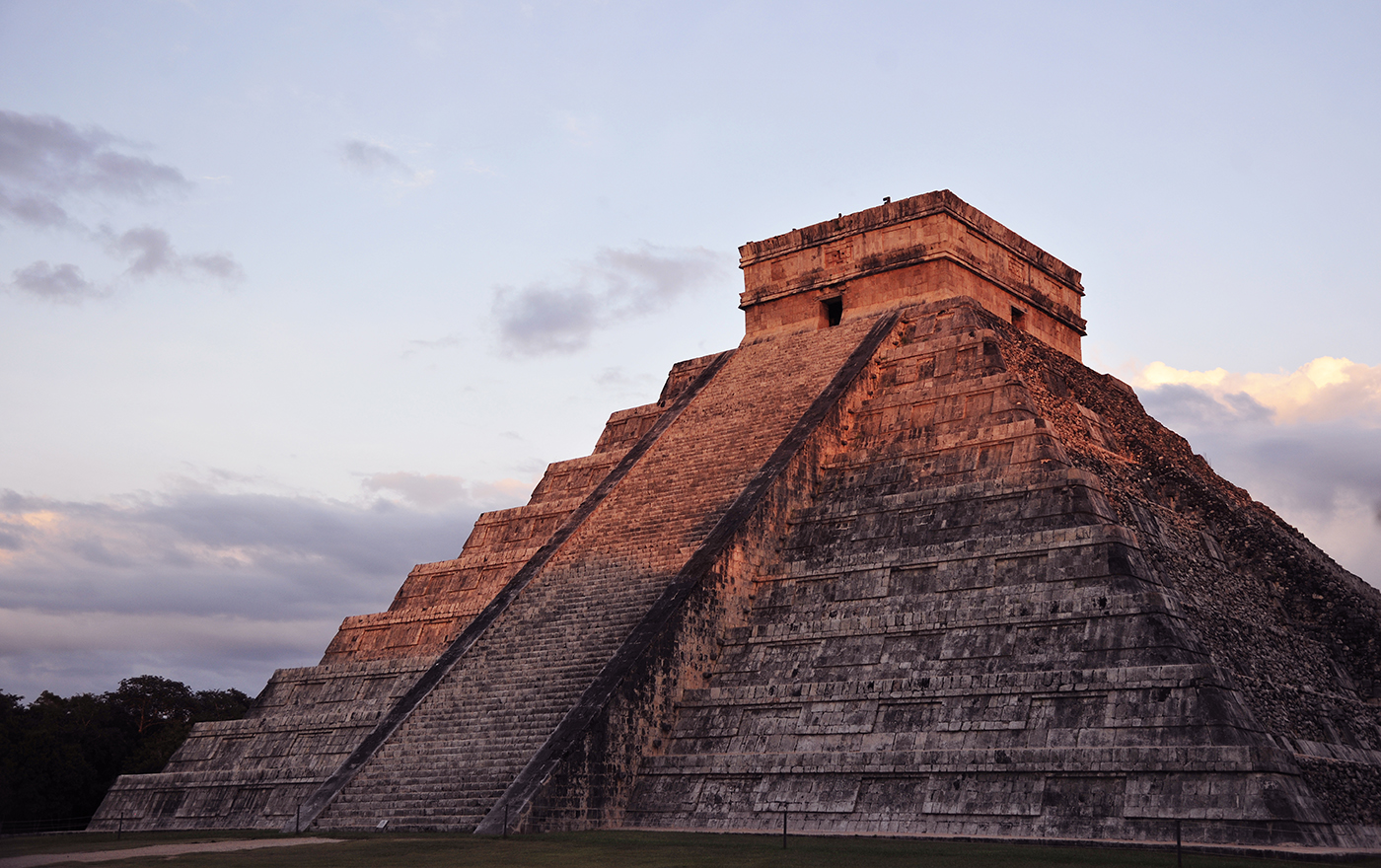
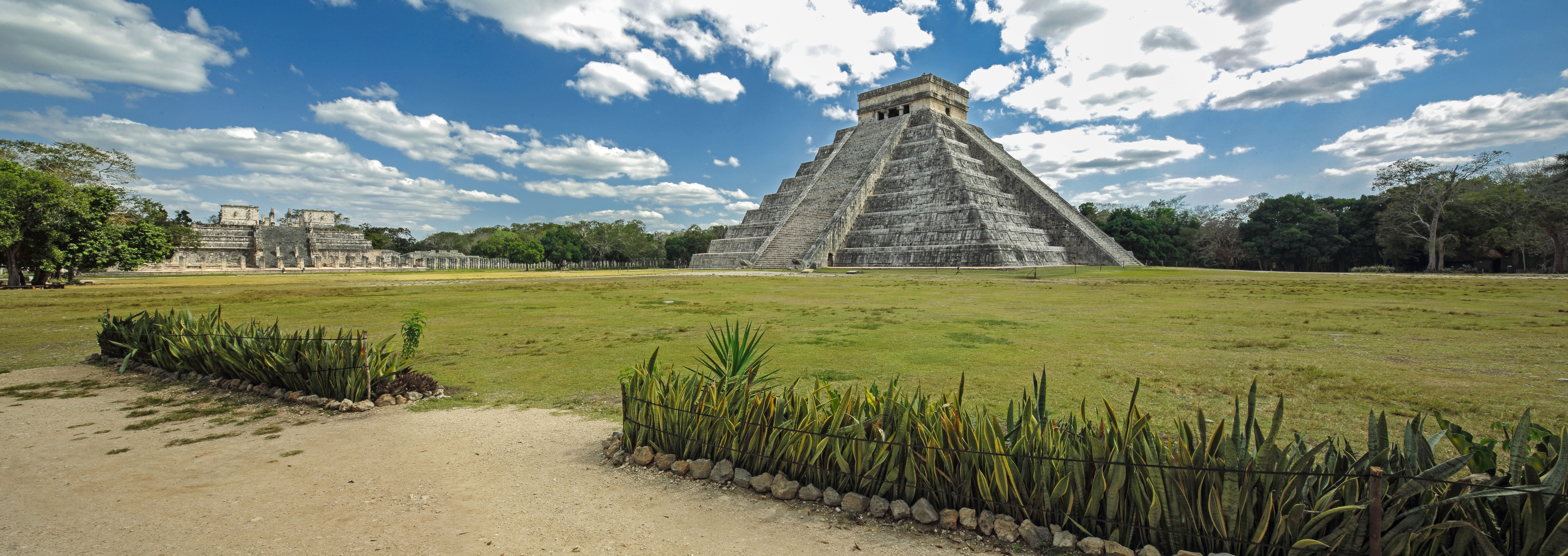
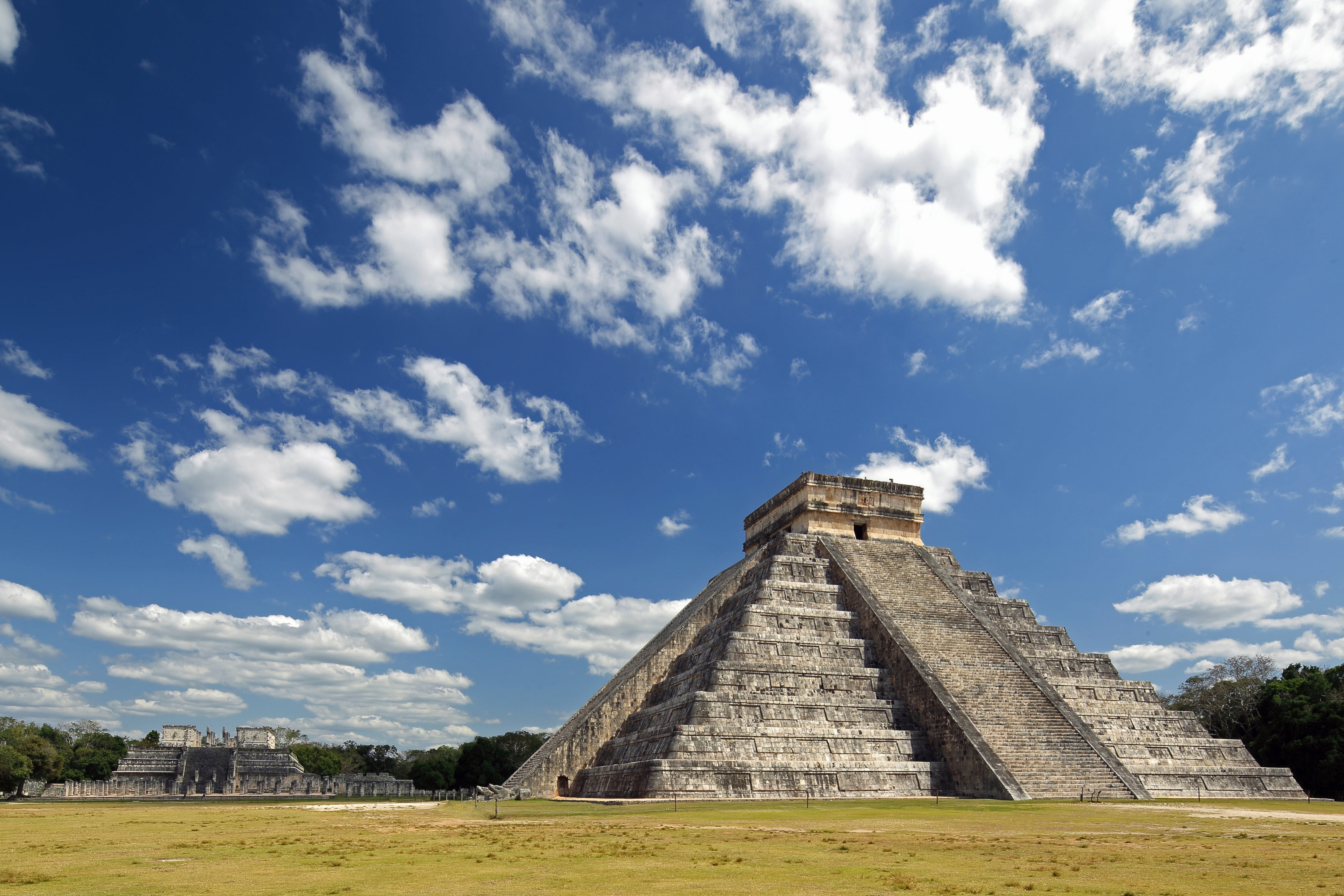
The worship of Kukulcan, or Quetzalcoatl, came from Tula, as well as the many-columned buildings, which are reminiscent of the shape of a snake. For example in the capital of the Toltecs, the remarkable Temple of a Thousand Columns honors Tlahuizcalpantecuhtli, the Lord of the Dawn, who was the embodiment of Quetzalcoatl. The city’s principal structure, El Castillo ("The Castle"), is also known as the Temple of Quetzalcoatl, and it is above all a representation of the solar calendar, and hence a monument to time itself. This and other tall square- or rectangular-based pyramid structures have long stairways edged with robust balustrades. These days this style is known Toltec Maya.
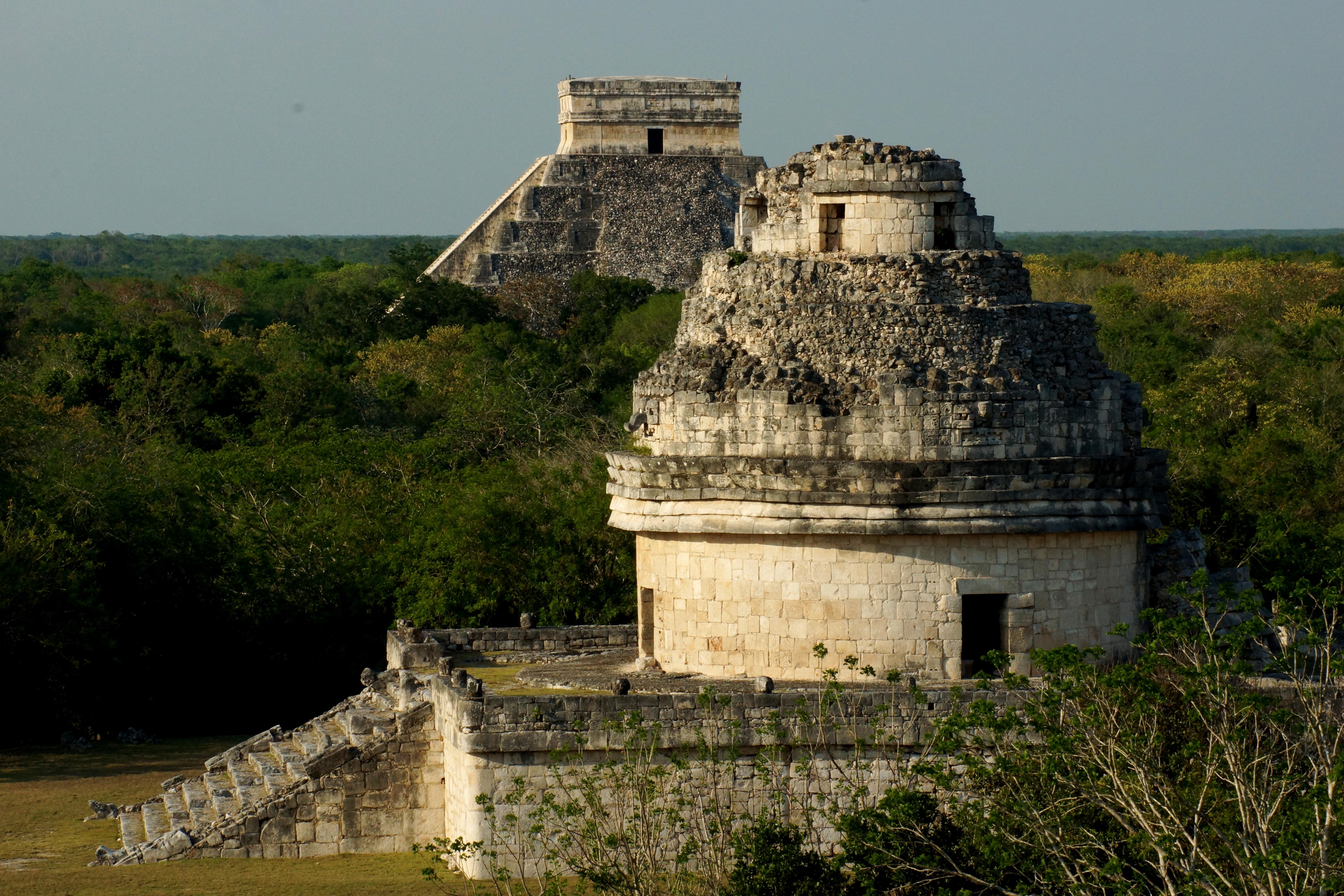
From the east of Yucatán it also received the Puuc-style filigree design in the form of elaborate decoration made from stucco facade masks of the rain god Chaac, and numerous polished stone fret patterns interspersed with small pillars and minor sculptures in low structures. There are also circular-plan buildings with an ancient heritage, such as the surprising observatory known as El Caracol (“The Snail”).
The great works began by levelling out the ground for the various platforms on which the palaces and temples were built including El Castillo, the Great Ball Court, the Temple of the Great Tables, the Temple of the Warriors, the Tzompantli, the Platform of the Eagles and the Jaguars and the Platform of Venus. El Mercado ("The Market”), the Temple of the Sculpted Columns and the Temple of the Small Tables were erected in one great quadrangular plaza.
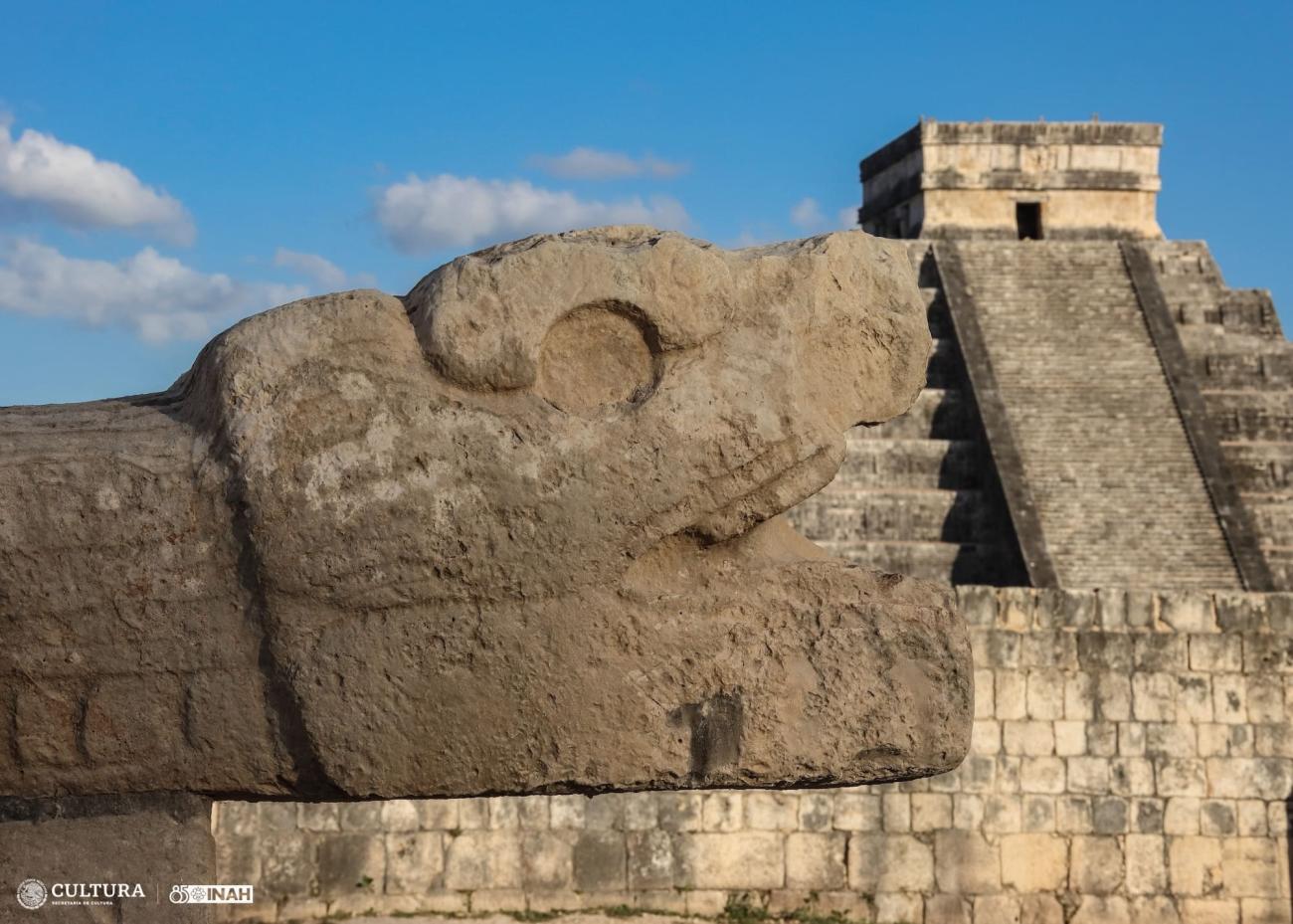
At the spring and fall equinoxes, a carefully calculated effect of light and shadow is produced by the shadow of the north staircase of the building known as the Castle or Pyramid of Kukulkan. The shadow forms the outline of a serpent, a phenomenon interpreted as the descent of the god Kukulkan to fertilize the earth and to ensure the continuity of the agricultural cycle that was so important to the Mesoamerican worldview.






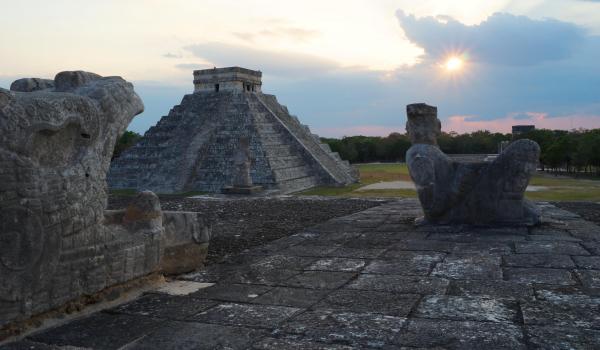
Gran Nivelación
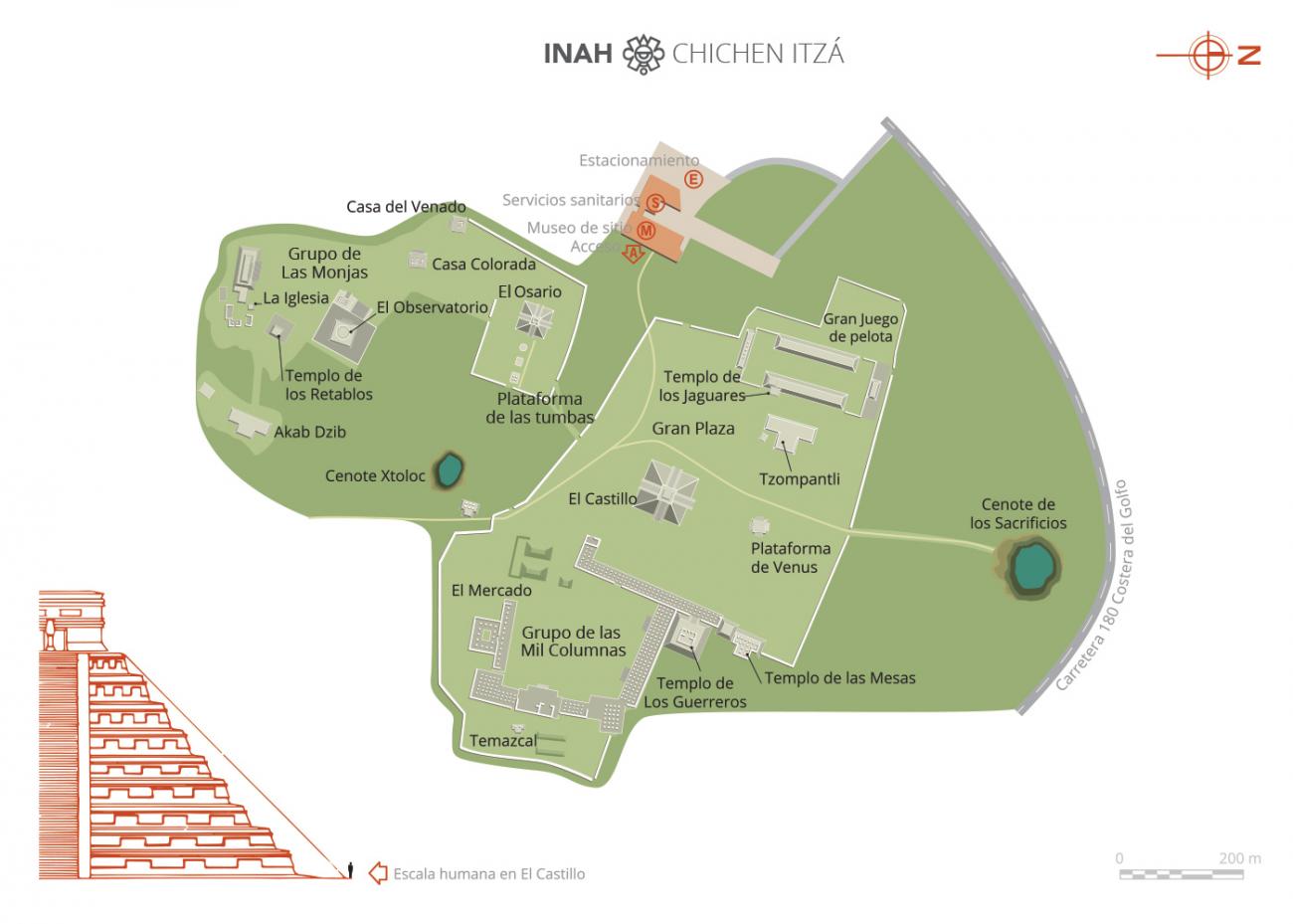
The main buildings are located on an enormous artificial platform. The buildings that stand out in this space are the Castle, the Ball Court, the Temple of the Great Tables, the Temple of the Warriors, the Tzompantli, the Platform of Eagles and Jaguars, and the Platform of Venus. The Main Plaza is…
Gran Nivelación



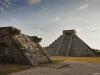

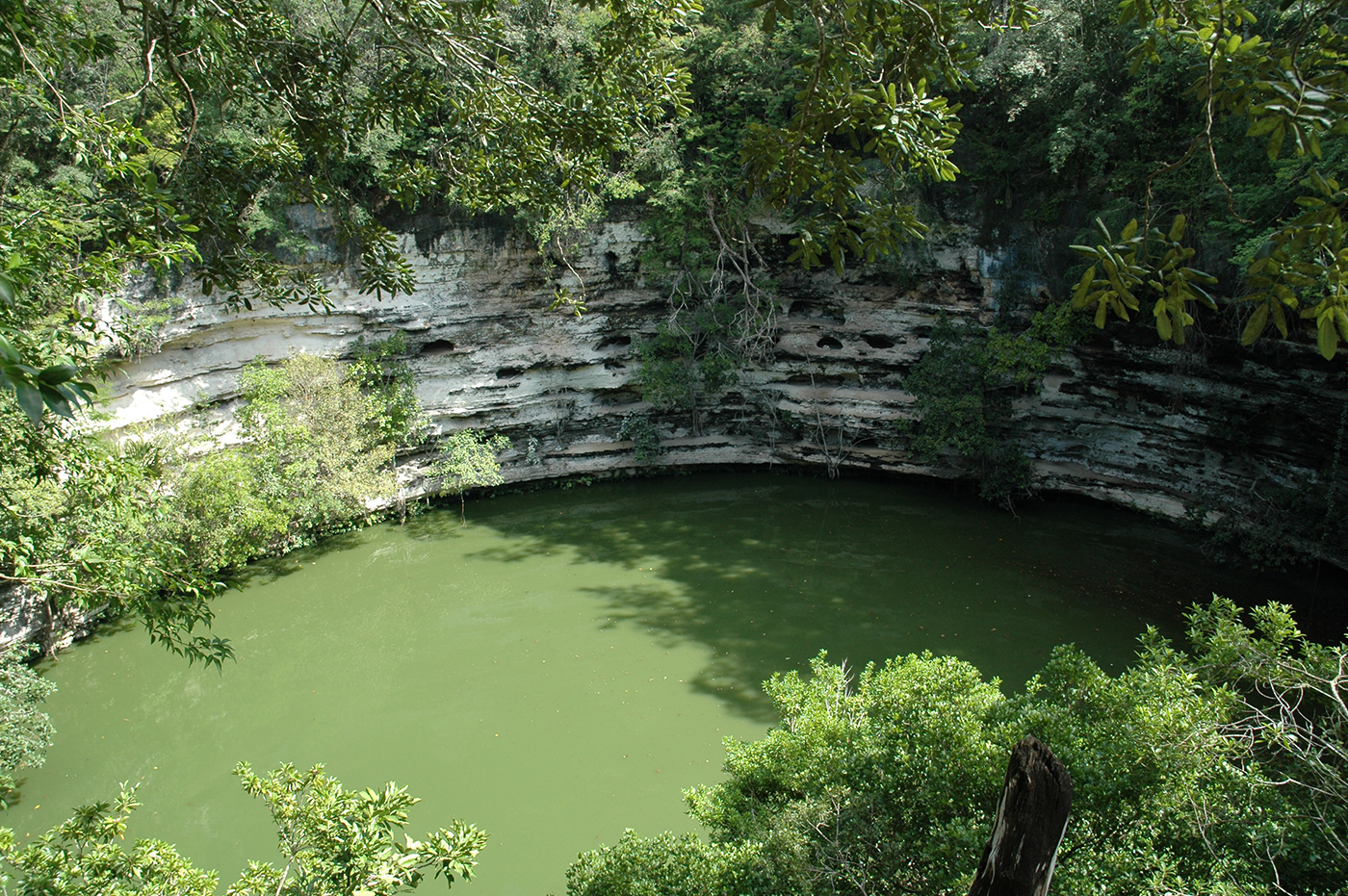
The main buildings are located on an enormous artificial platform. The buildings that stand out in this space are the Castle, the Ball Court, the Temple of the Great Tables, the Temple of the Warriors, the Tzompantli, the Platform of Eagles and Jaguars, and the Platform of Venus. The Main Plaza is connected to the Sacred Cenote by a sacbé to the north side.
The buildings found in this space present architectural features typical of the Mayan area that merge with features of central Mexico, which has led some researchers to catalog this fusion as a Mayan-Toltec style.
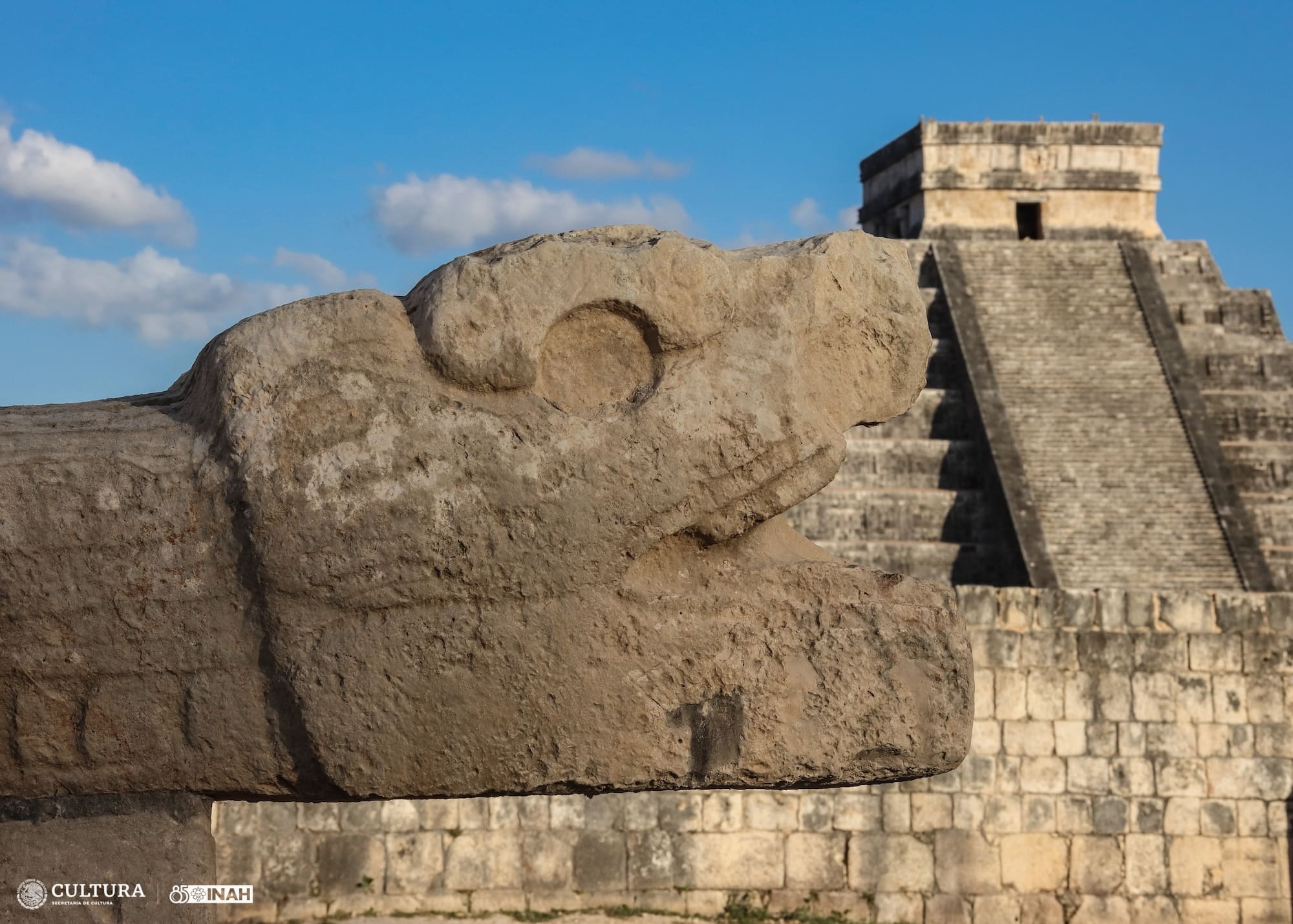
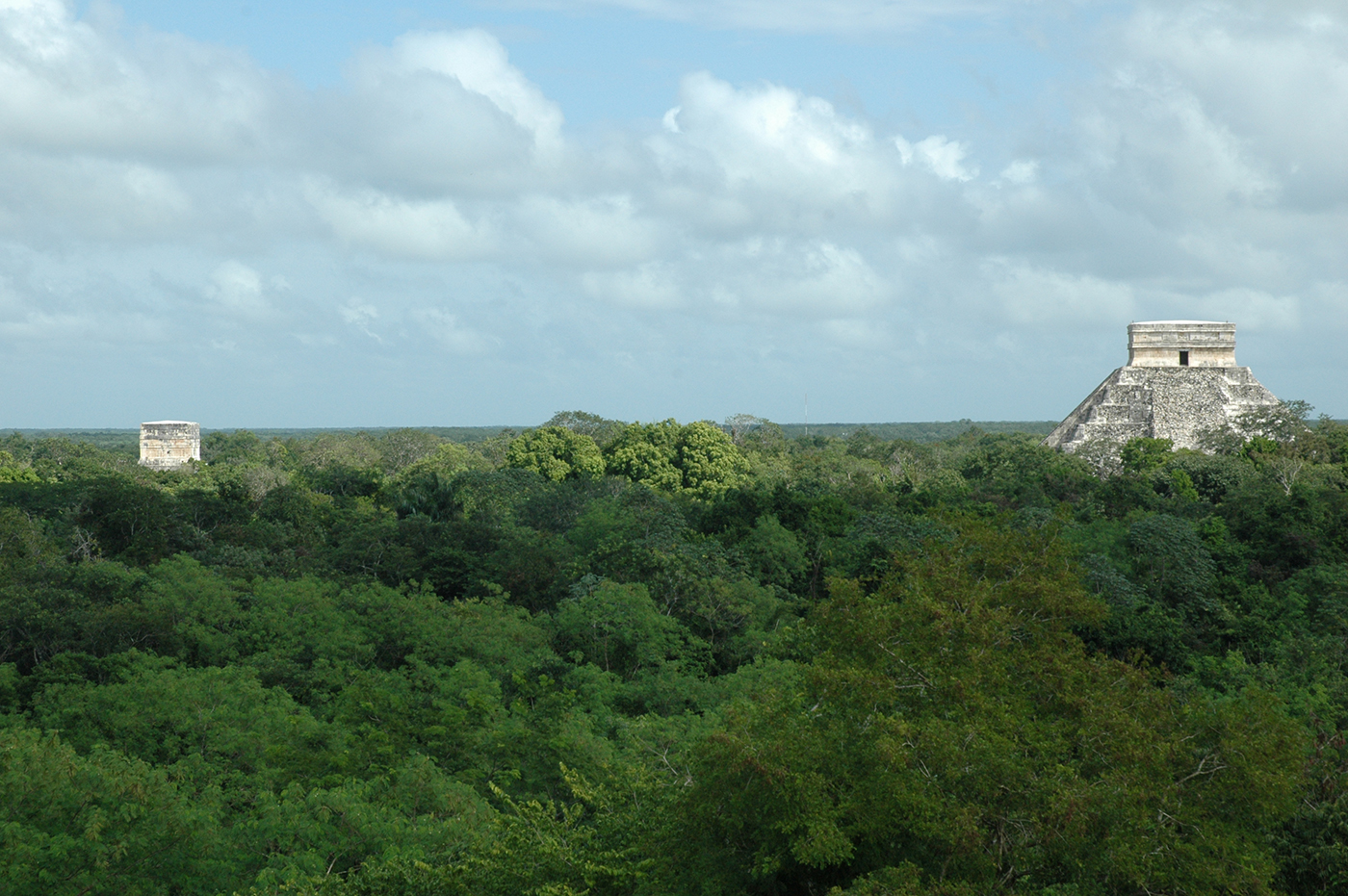
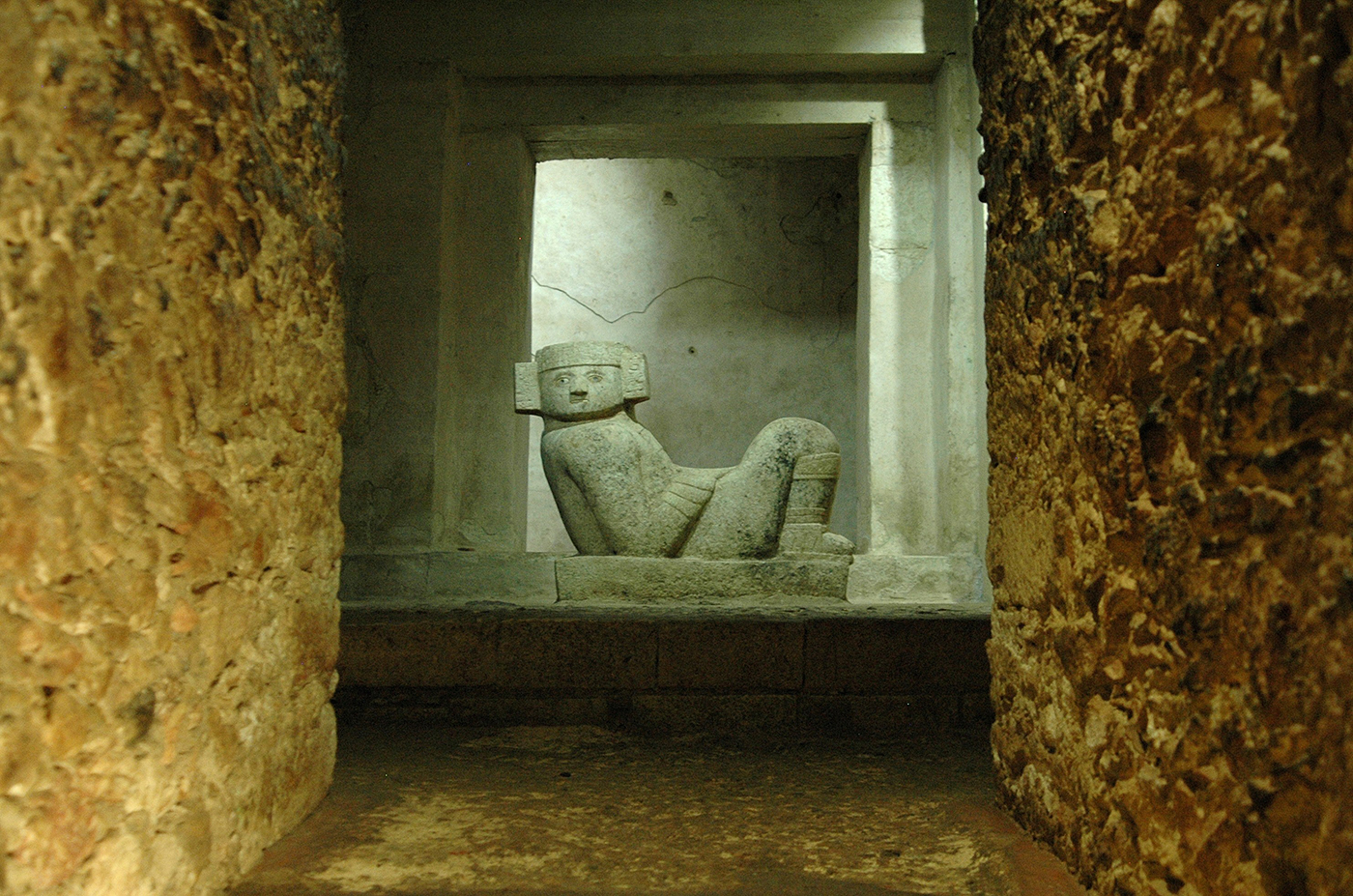
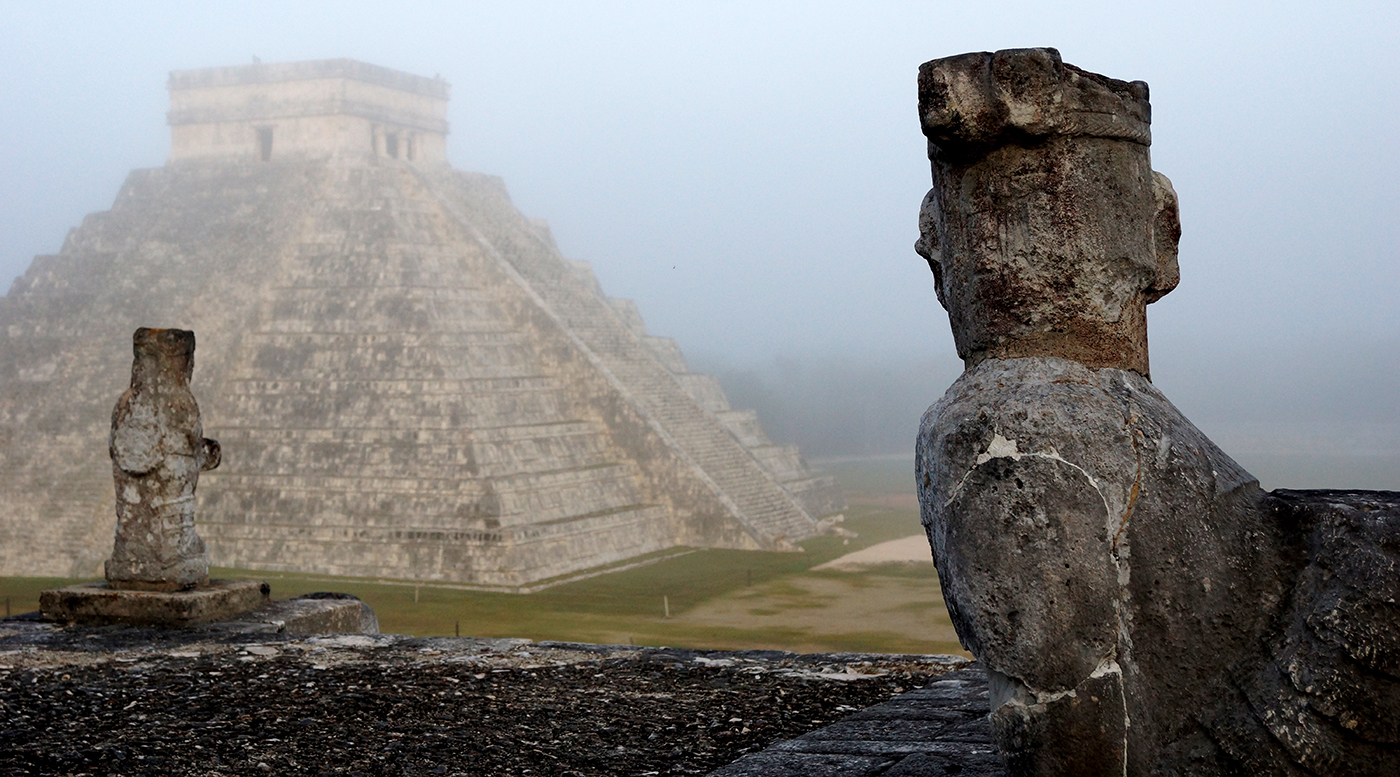
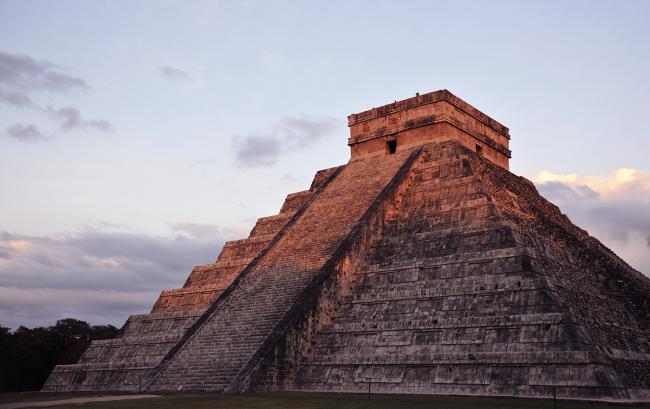
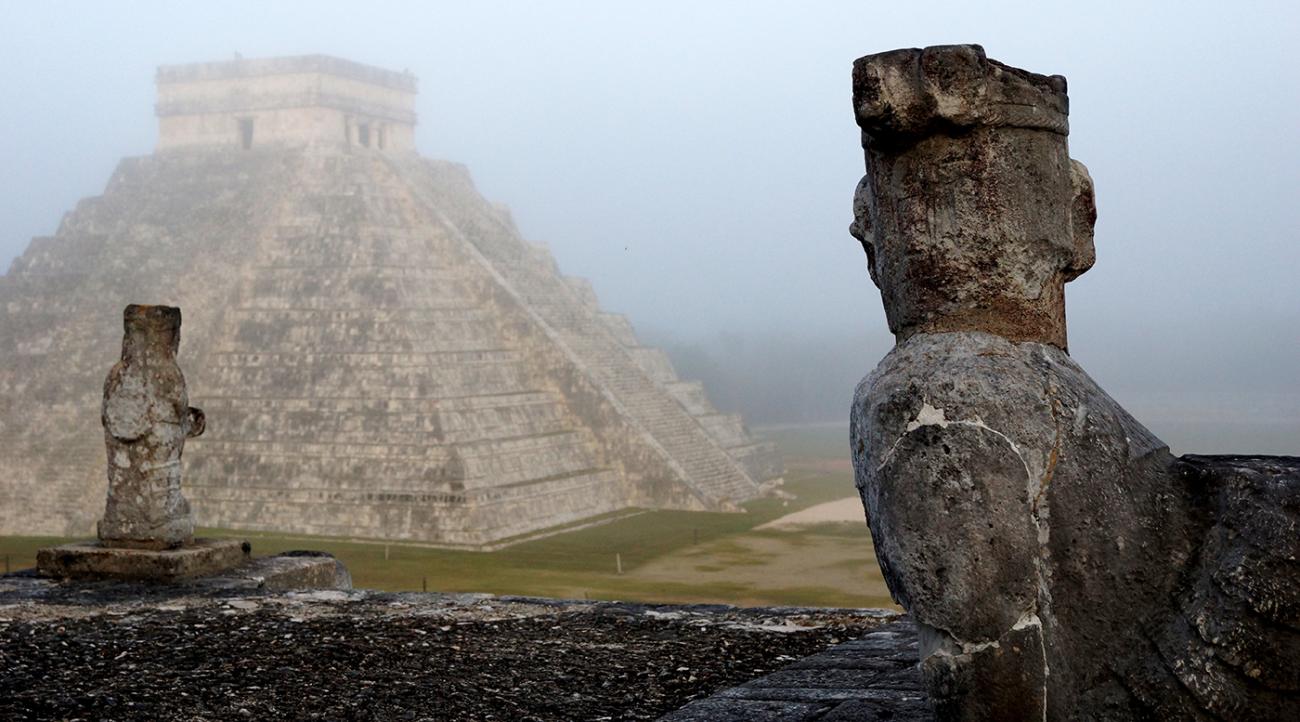
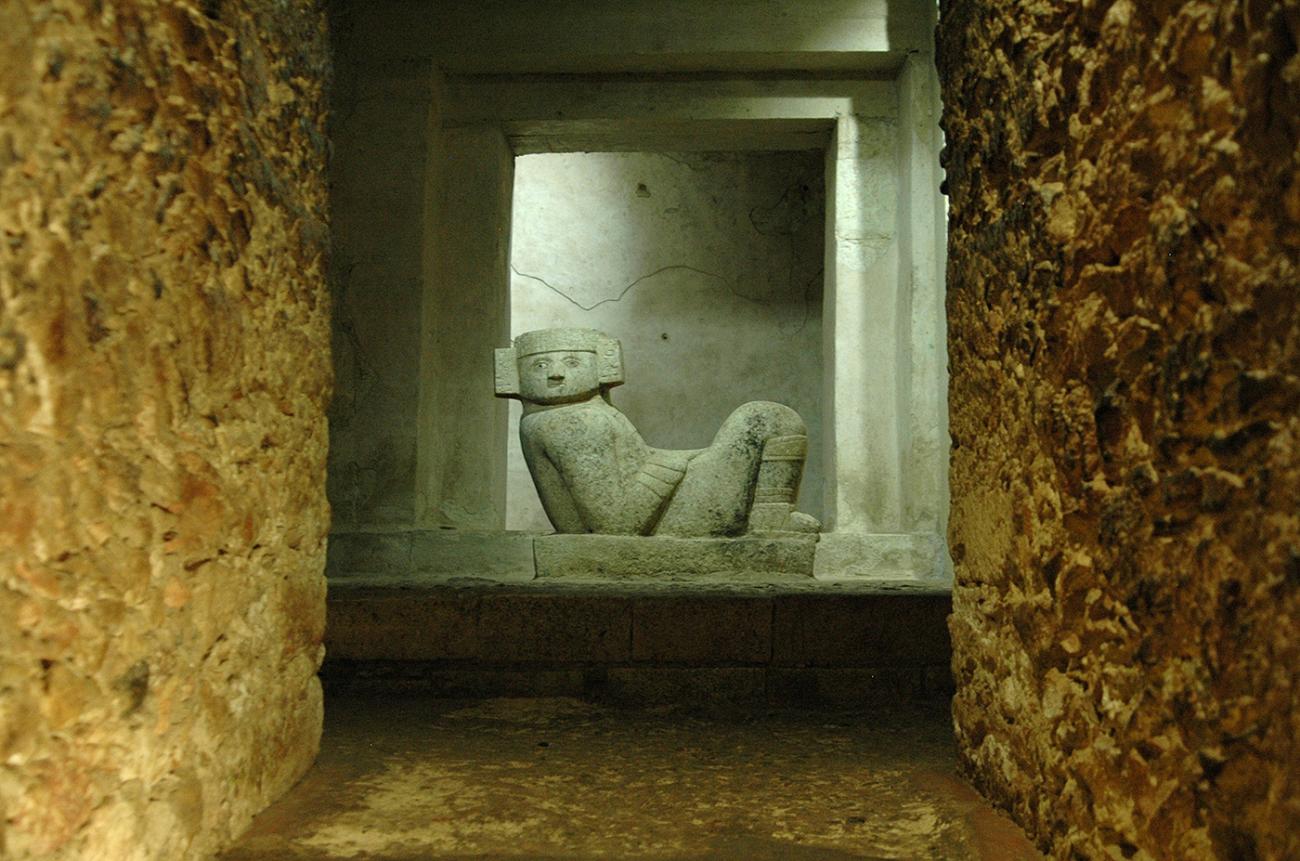
The Castle: Undoubtedly the most imposing construction of Chichén Itzá. It is located in the western sector of the Great Leveling: a quadrangular base with nine staggered bodies of inclined faces and decorated with panels, stairways and alfardas on its four sides (although the stairway in the lower part of the building, whose alfardas are associated with snake heads, suggests that the north side was the main side of El Castillo). On top of the basement is a temple with four entrances; the main façade faces north and houses an enclosure with a front room and a back room. El Castillo had the function of a temple and is associated with Kukulkan, a character who may have been the ruler of Chichen Itza in the tenth century AD and who, after his death, served as a deity linked to the spring and autumn equinoxes. The Castillo dates from the Terminal Classic period; it was built over a first temple that has a stairway with alfardas, but without serpent heads on its north side. This stairway ends at the top in a temple with two chambers, one north and one south. A sculpture of Chac Mool was found in the north chamber and a jaguar throne painted red in the south chamber. The feline rests on its four extremities, its head is on its left side and a turquoise and jade disk was found on its back, the animal seems to have been sacrificed by means of fire. Other felines in walking position are appreciated in the friezes of the substructure of El Castillo and are directed towards the front part of the construction.
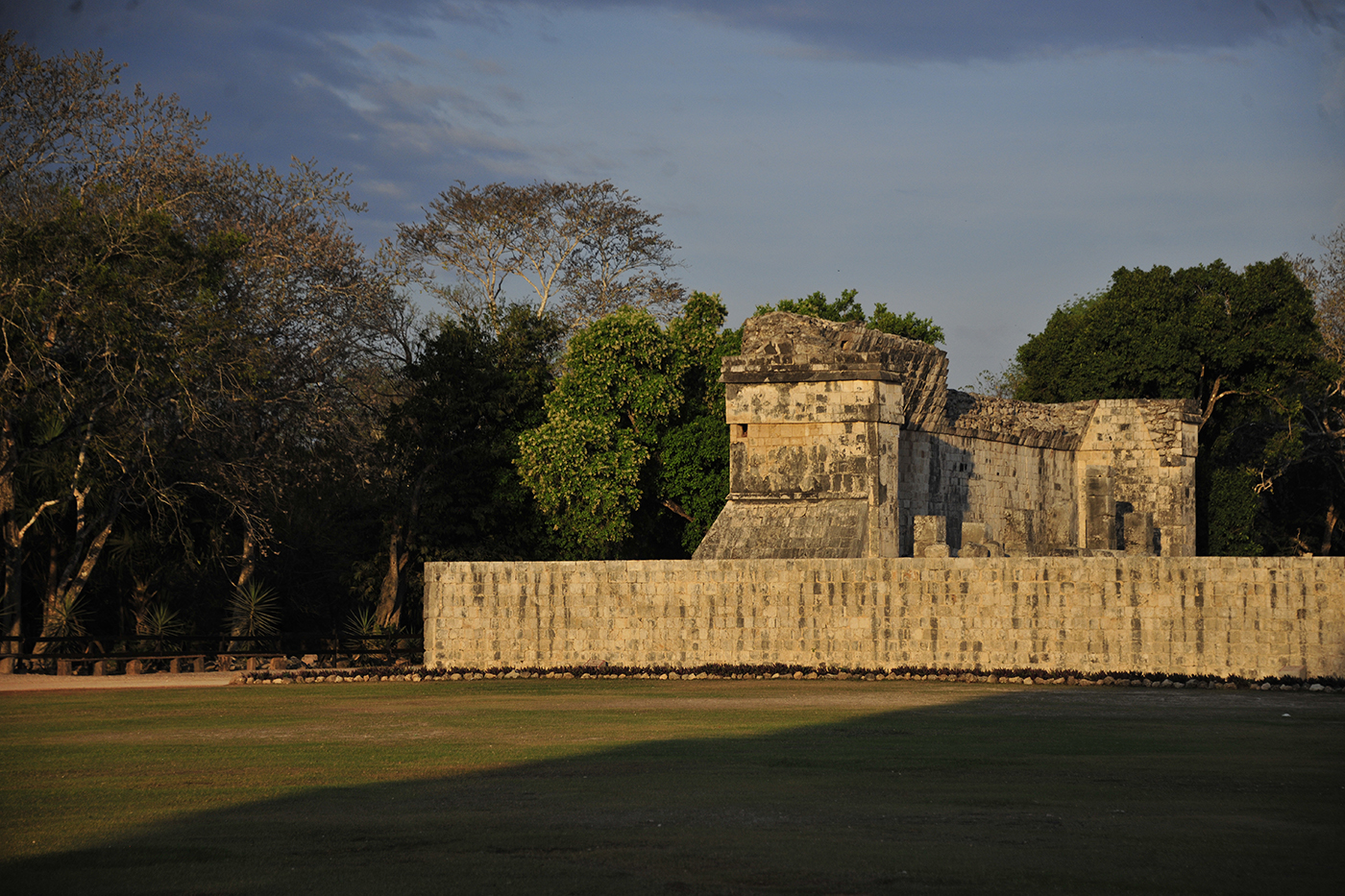
Ball Court: It is located in the northwest corner of the plaza. Seen from the interior, it is composed of two elevated and parallel walls in the center of which are embedded two stone rings and benches adorned with bas-reliefs. At each end of the court there is a pavilion or grandstand. In the east wall, the Temple of the Jaguars is located, in whose later part is a totally sculpted chamber; in her polychrome representations of warriors, priests and of multitude of animals and aquatic plants are observed, which gives to understand that the ball game, besides to have been a sport event, also had religious character.
Temple of the Jaguars: Located on the east platform of the Great Ball Court, this small temple is one of the most remarkable of Chichén Itzá, both for its architectural design and its rich and complex decoration, undoubtedly associated with the rite of the game. The temple at the top shows two large columns in the form of rattlesnakes with open jaws. The friezes are decorated with bands representing intertwined snakes, jaguars and shields. In the interior of the temple there were mural paintings with war scenes.
North Temple of the Ball Game: It is located at the end of the Ball Game; surely ritual activities were carried out there. In the interior of this temple there is a panel with reliefs that show different scenes in which more than 40 characters participate.
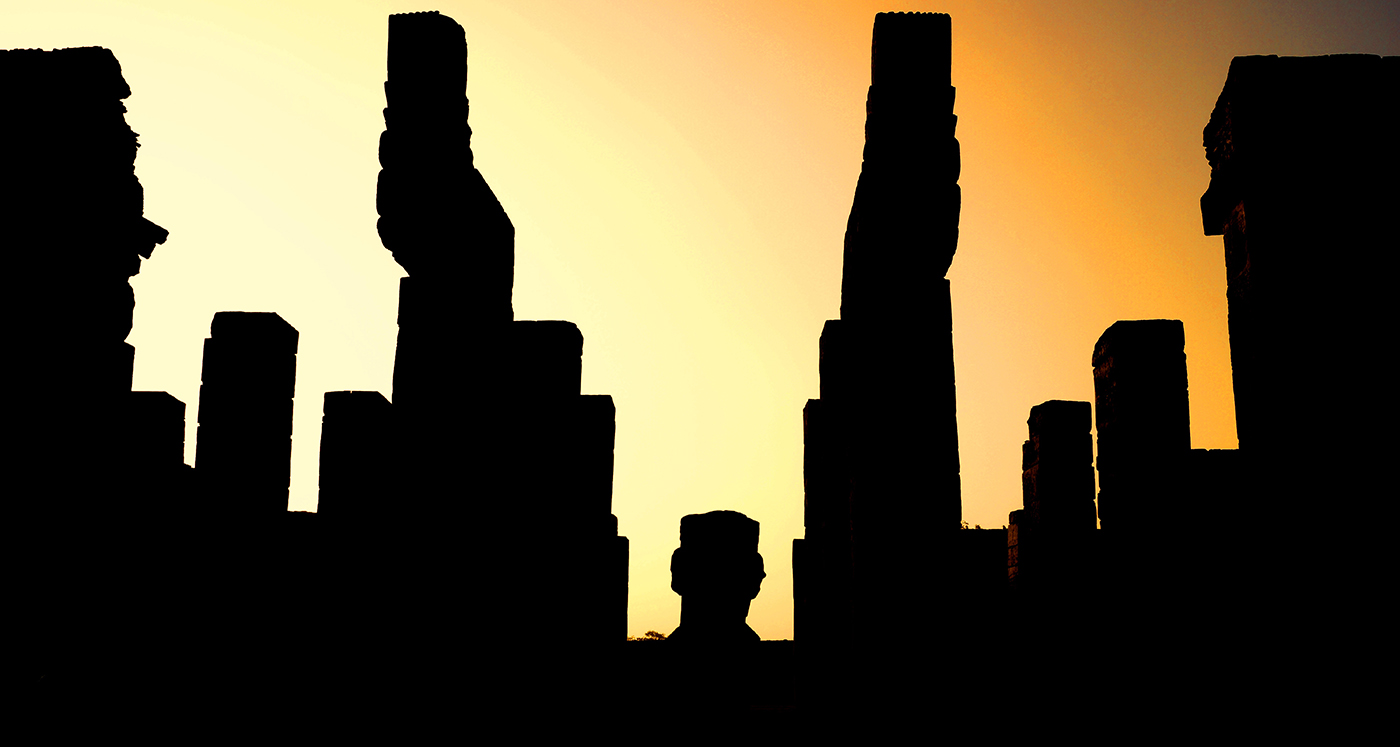
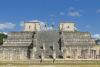
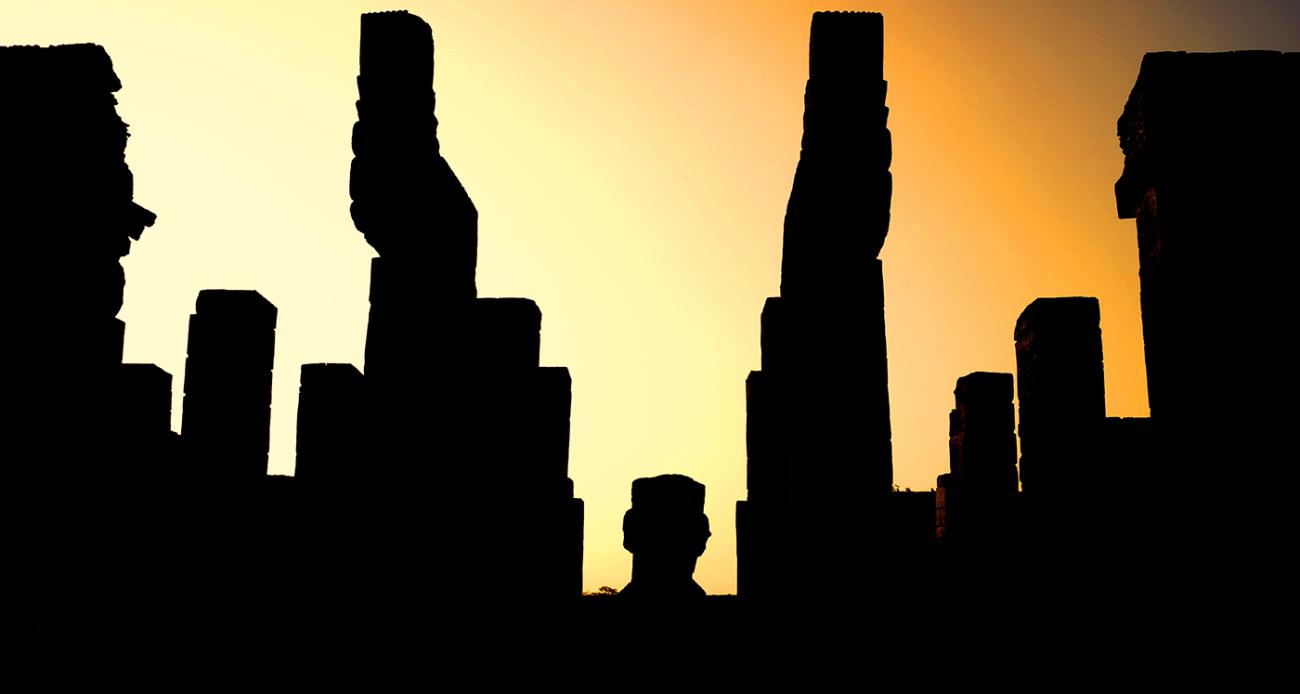
Temple of the Warriors: This construction, of quadrangular plant, presents four staggered bodies and a single stairway in its western side, flanked by alfardas. Two standard bearers finish off the upper part of the alfardas. The stairway begins on a platform with pilasters, which show effigies of warriors, and ends at the top, where there is a large room that houses several pilasters. A sculpture of Chac Mool and two large serpent heads, with open jaws and forked tongues, show the access to the upper room of the building. In the interior of this room, in its back side, there are several stone slabs supported by sculptures called atlantes. The front of the Temple of the Warriors is decorated both by representations of the narigod god of rain, Chaac, and the snake-bird-man.
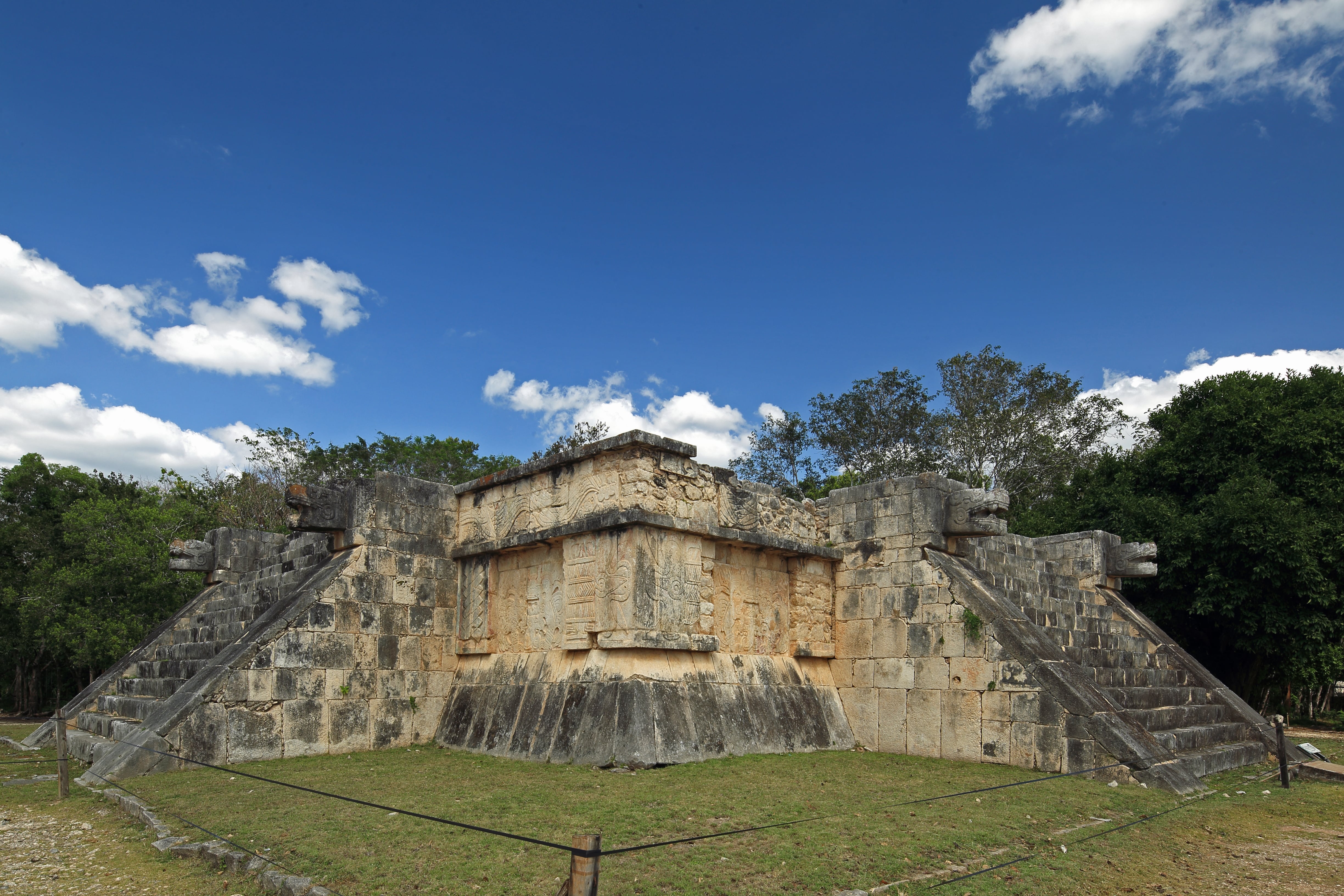
Platform of Venus: Low platform with staircases on its four sides, by which the upper part is accessed, where there are no constructions. The staircases of both platforms have alfardas that finish in their superior part with heads of snakes of great size. The Venus Platform is located directly to the north of El Castillo, and has as main motif stars cut in half, which are representations of the planet Venus, as the celestial body of the morning.
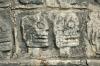
The Tzompantli: This construction is a low platform with a stairway on its east side, whose exterior façade has, as its main motif, the representation of skulls. The name of this structure comes from the Nahuatl tzompantli which means wall of skulls.
Grupo de las Mil Columnas
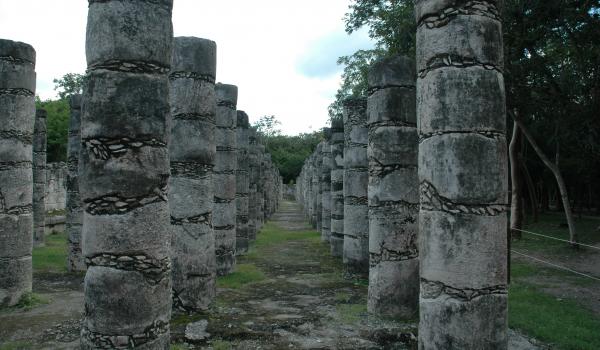
Quadrangular plaza of large dimensions, which is composed of galleries and temples formed by columns that supported large vaults. The buildings that stand out in this space are the Market, the Temple of the Sculpted Columns and the Temple of the Small Tables.Palace of the Sculpted Columns: For its…
Grupo de las Mil Columnas


Quadrangular plaza of large dimensions, which is composed of galleries and temples formed by columns that supported large vaults. The buildings that stand out in this space are the Market, the Temple of the Sculpted Columns and the Temple of the Small Tables.
Palace of the Sculpted Columns: For its outstanding work of bas-reliefs in jambs and columns, it is one of the most important buildings on the east side of the Square of the Thousand Columns. Its architectural characteristics denote a civic-religious function. It has a front gallery and a series of interior bays.
Originally its three facades were decorated with geometric drawings, characters and masks of the narigudo god. In its interior there are walls of later constructive stages that close the space between the columns.
Grupo del Osario
It is a secondary plaza, connected to the Great Leveling by means of a sacbé to the south side of El Castillo. The plaza is conformed by a pyramidal base similar to El Castillo, a circular platform, a Platform of Venus and to the east it is communicated with the Cenote Xtoloc by means of another…
Grupo del Osario


It is a secondary plaza, connected to the Great Leveling by means of a sacbé to the south side of El Castillo. The plaza is conformed by a pyramidal base similar to El Castillo, a circular platform, a Platform of Venus and to the east it is communicated with the Cenote Xtoloc by means of another sacbé. This one has the same plan as the Great Leveling but with a different orientation.
Platform of Venus: Very similar to the one found in the Plaza de El Castillo. It has reliefs that show representations of a man-bird-serpent, Quetzalcóatl-Kukulcán like morning star, and in the corners, tied of years next to the symbol of the planet Venus. In the upper panels Venus is seen among the undulations of cloud serpents.
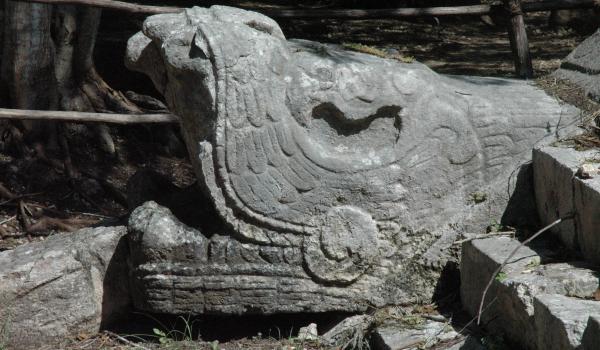
The Ossuary: The Ossuary has four staircases with alfardas, formed by intertwined serpents that finish in the superior part, in a space that was occupied by a temple decorated with representations of men-bird-serpent. It is composed by seven staggered bodies of inclined faces; in three of the bodies of the superior part there are boards with representations of God K, associated with cacao seeds, jewels and fruits. Two columns in the form of feathered serpents indicate the access to the temple, in whose interior there is a pilaster with the representation of a captive individual. The date, 998 A.D., is associated with this character.
Platform of the Tombs: It is a building that perhaps functioned as an ossuary. During its exploration several secondary burials were located. Its most notable feature are the columns that supported a roof of perishable material.

Grupo de la Casa Colorada
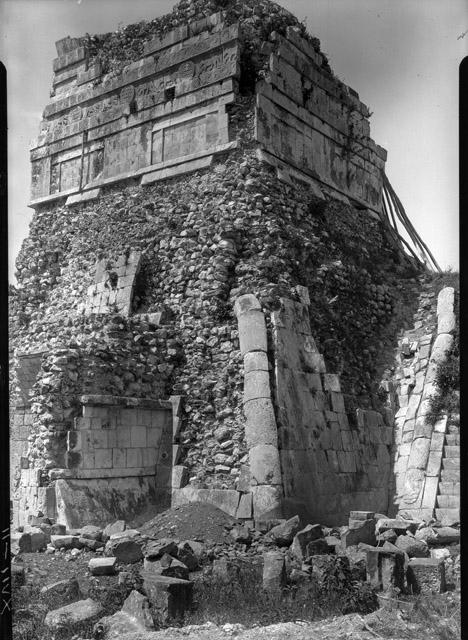
It is a small quadrangular plaza formed by the Casa Colorada, the Casa del Venado, a platform that has a stela, and another one that has not been intervened.This group is associated to the Observatory by means of a small sacbé. This last building was used by the ancient Maya for astronomical…
Grupo de la Casa Colorada
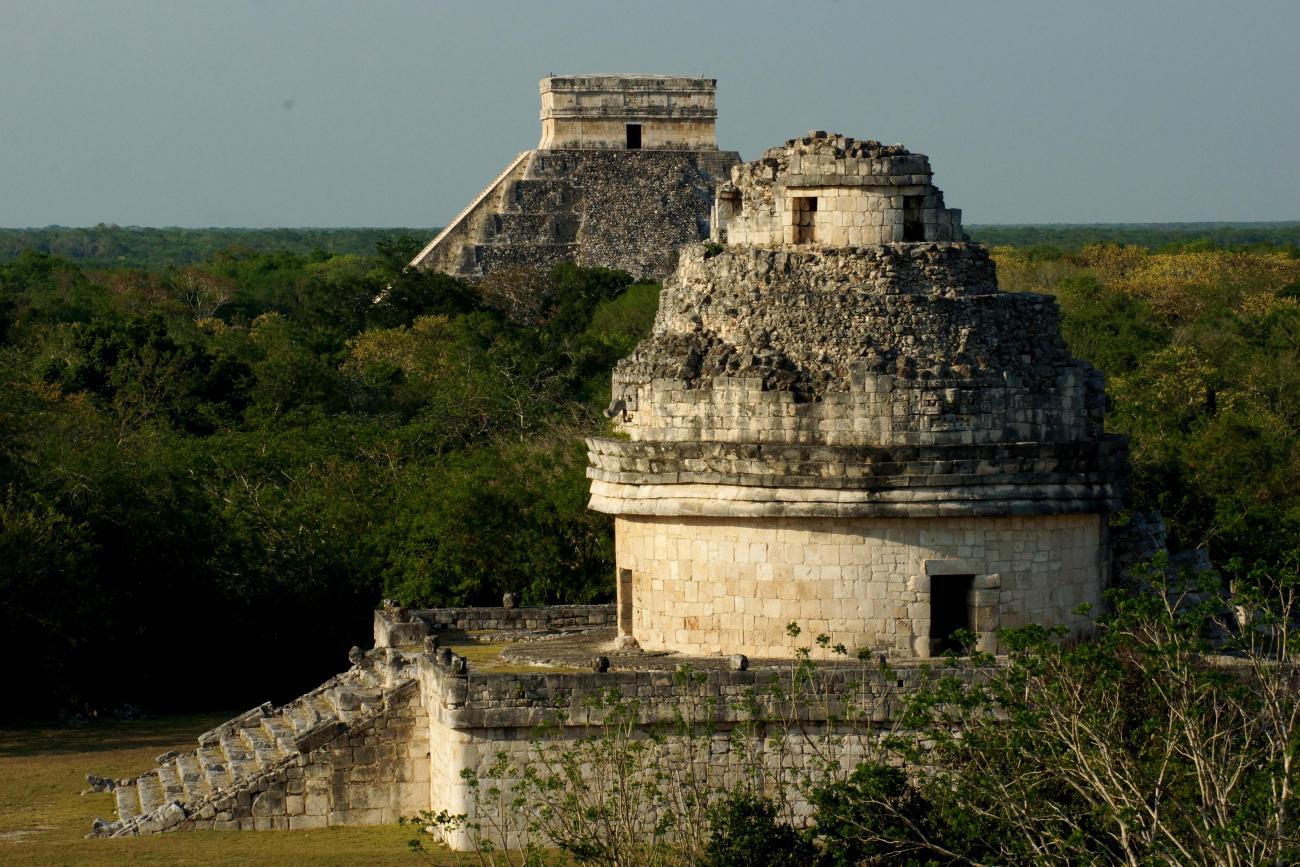




It is a small quadrangular plaza formed by the Casa Colorada, the Casa del Venado, a platform that has a stela, and another one that has not been intervened.
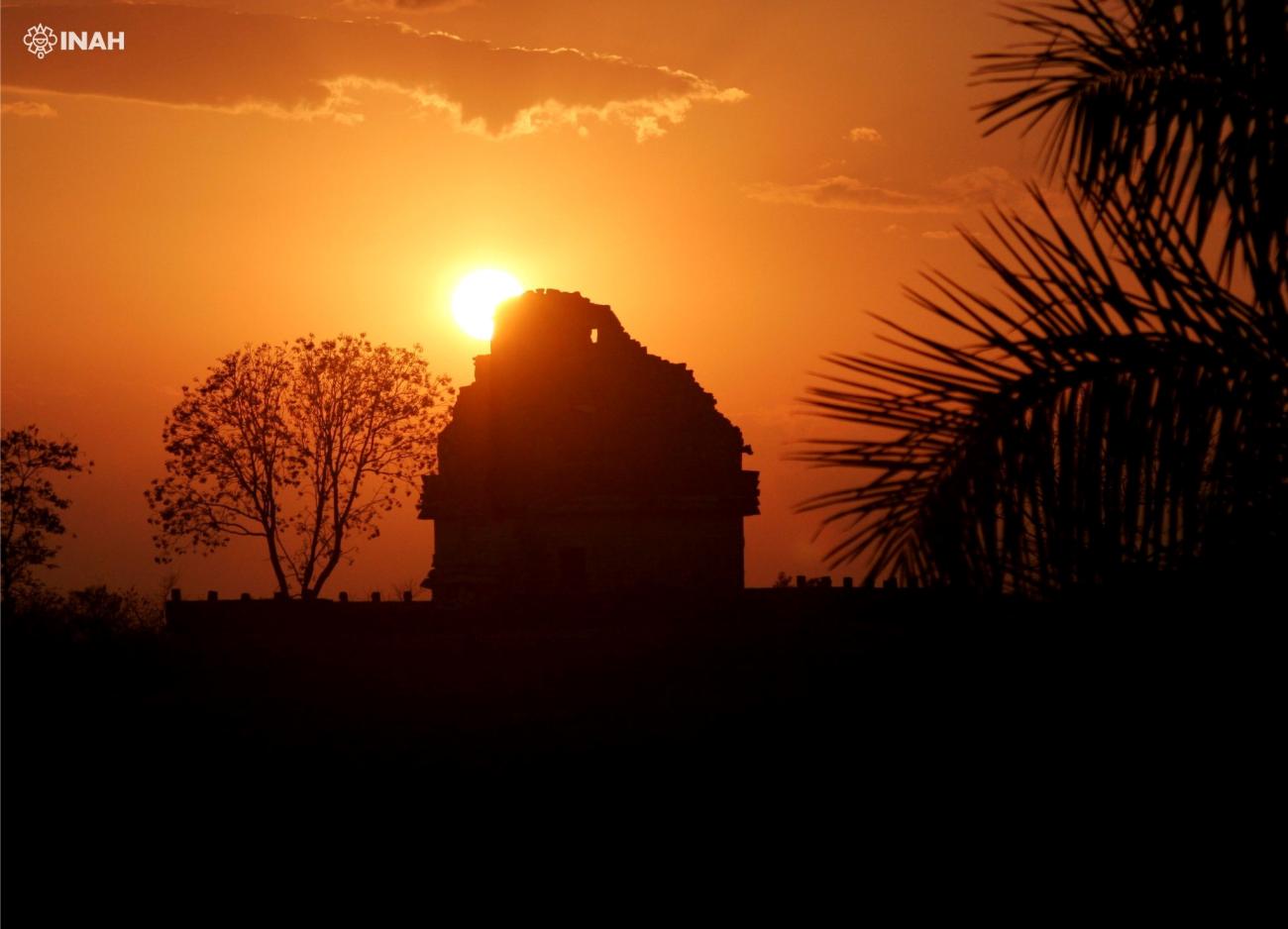
This group is associated to the Observatory by means of a small sacbé. This last building was used by the ancient Maya for astronomical observations.
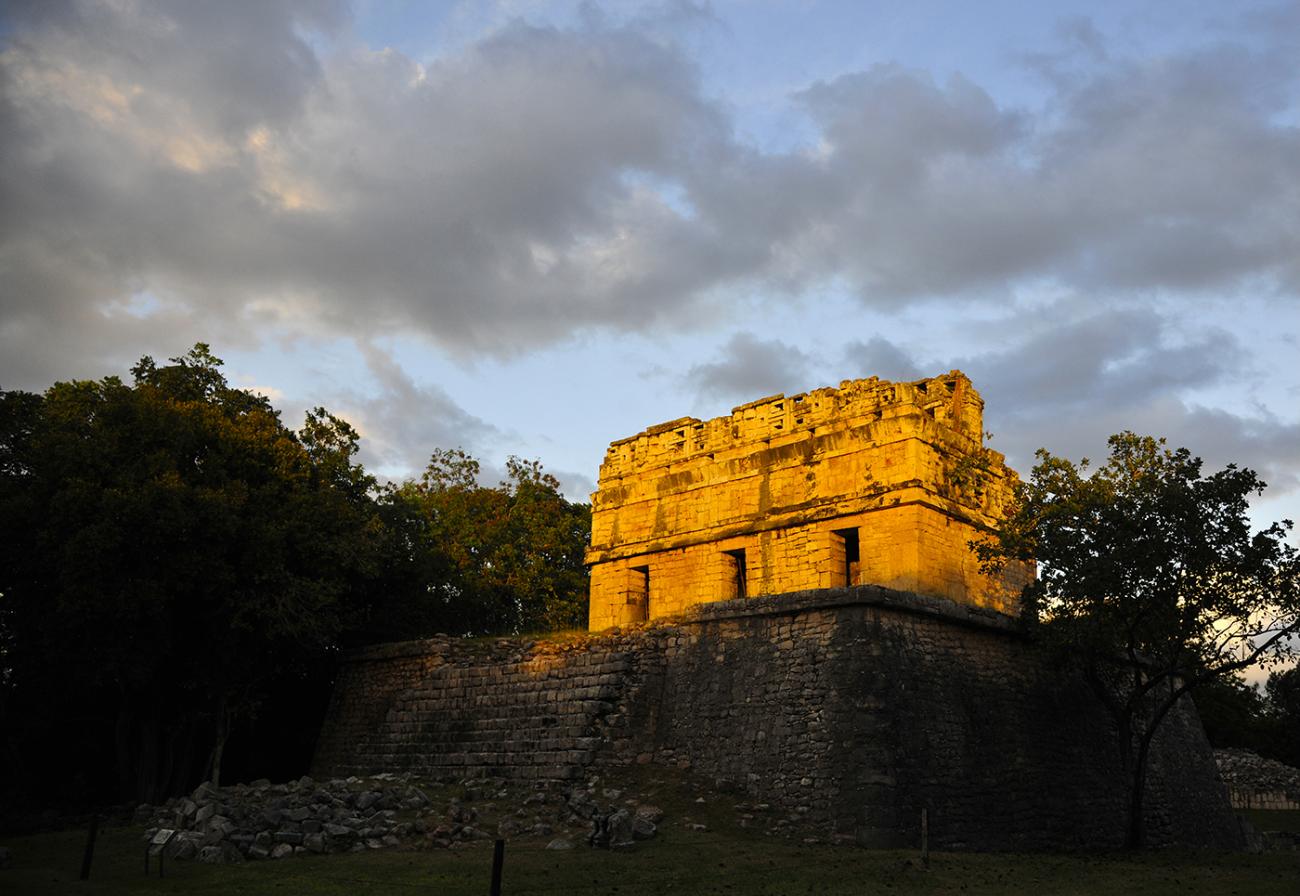
Casa Colorada or Chichanchob: The name of the building is due to the remains of red paint located in its interior, and to the openwork crests. The building must have had a religious and public function, because it has attached to the east a ball game court with reliefs in Maya-Toltec style (Arqueología Mexicana, special edition No. 27, Mexico, Editorial Raíces).
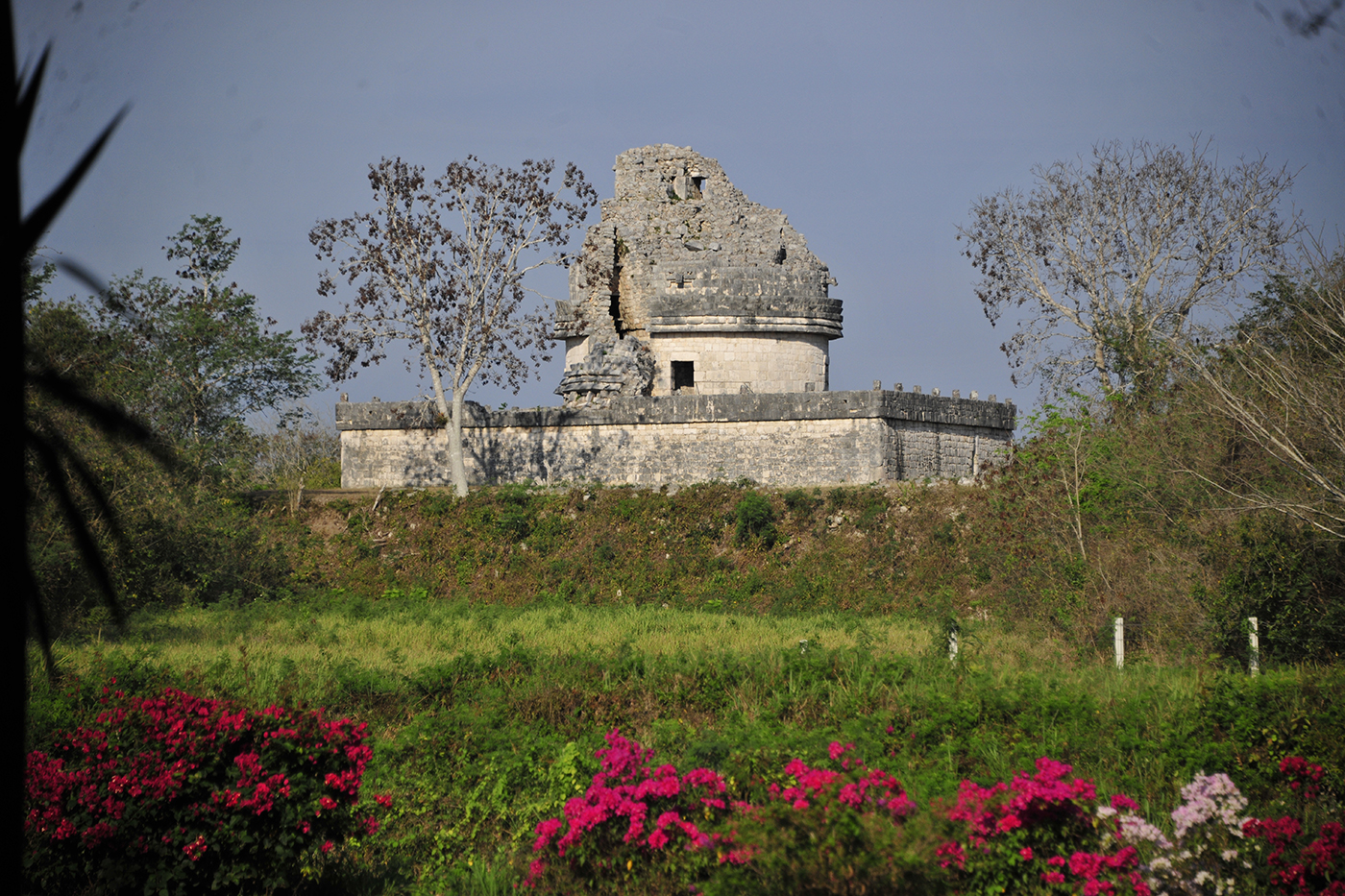
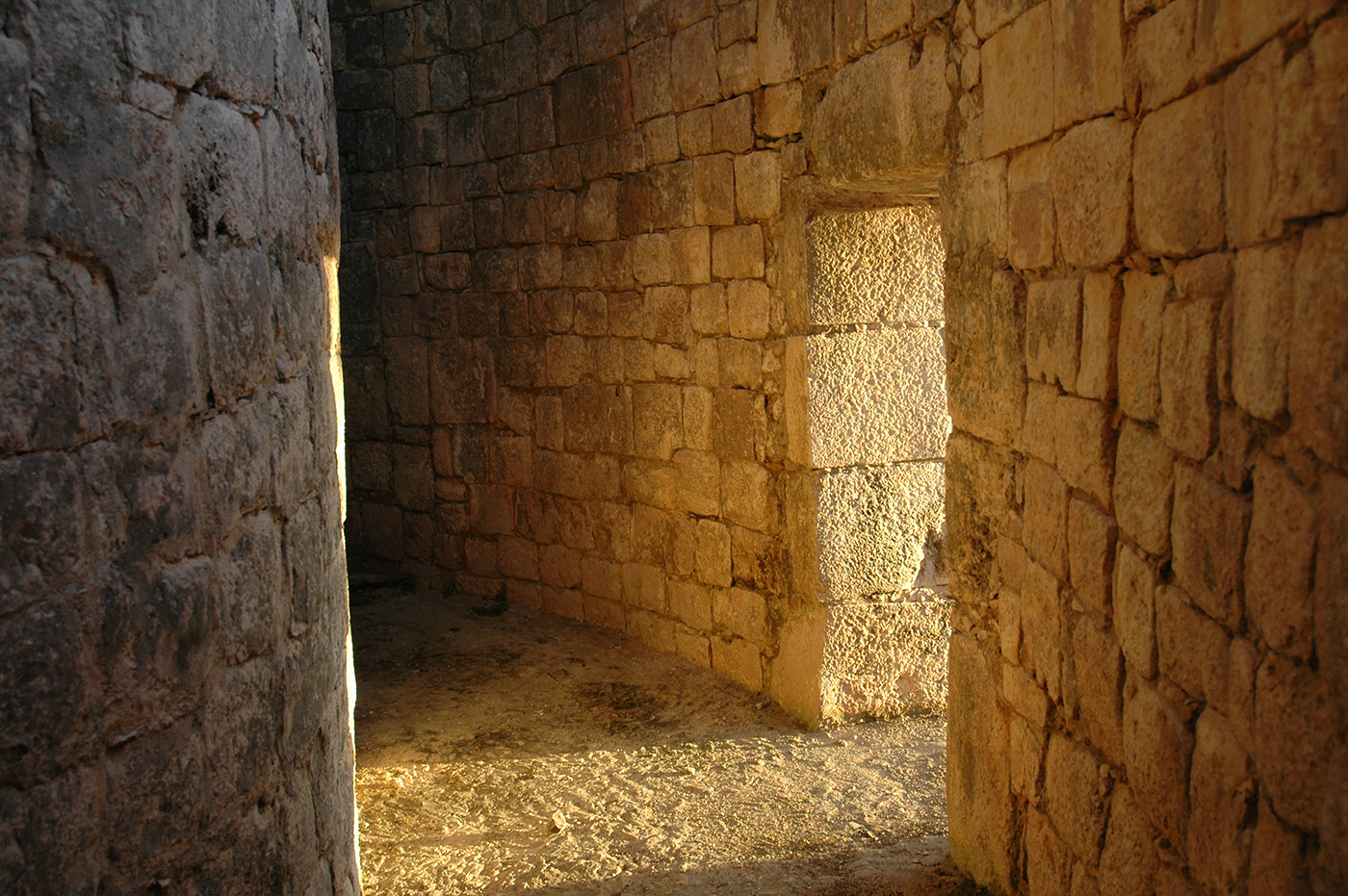
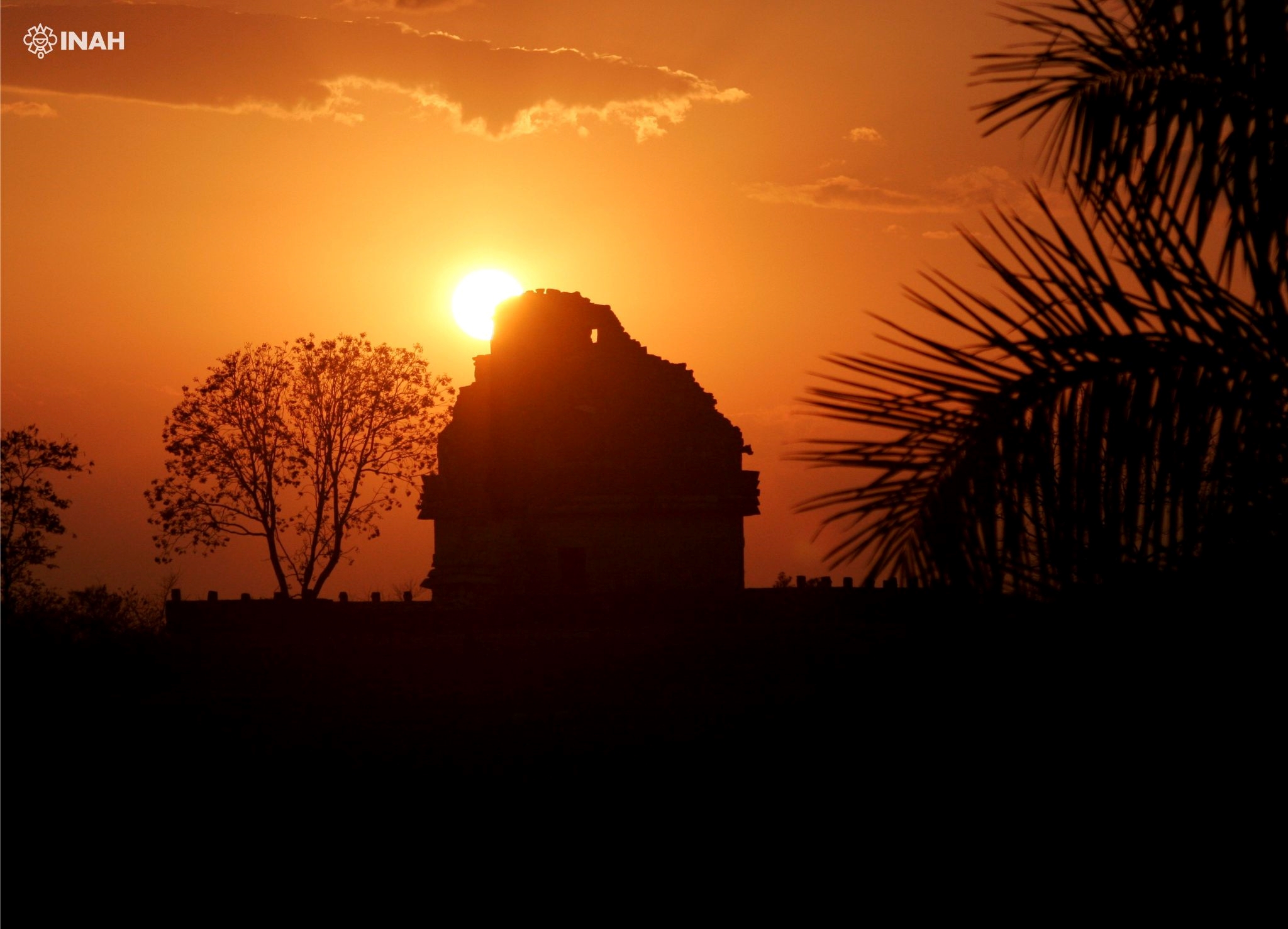
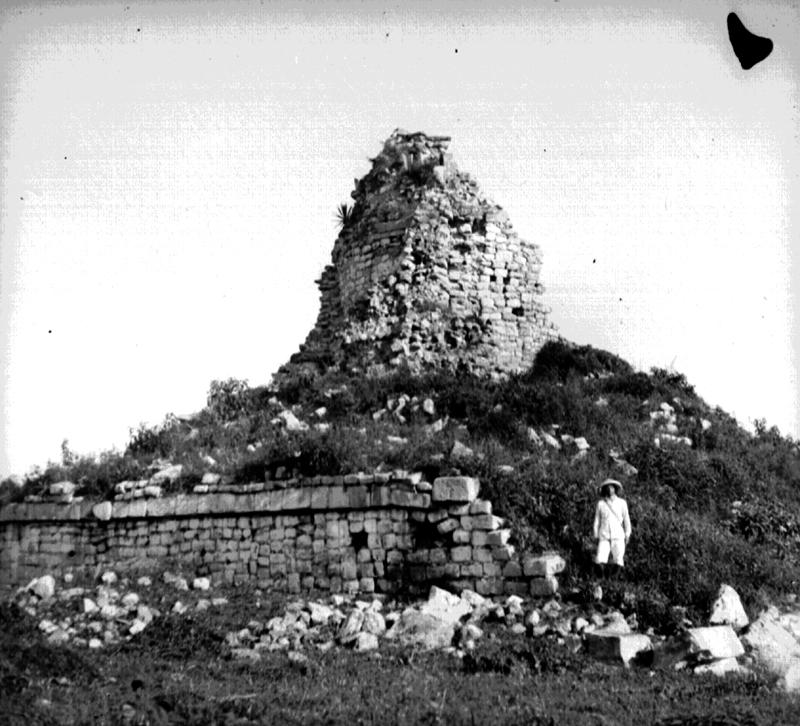
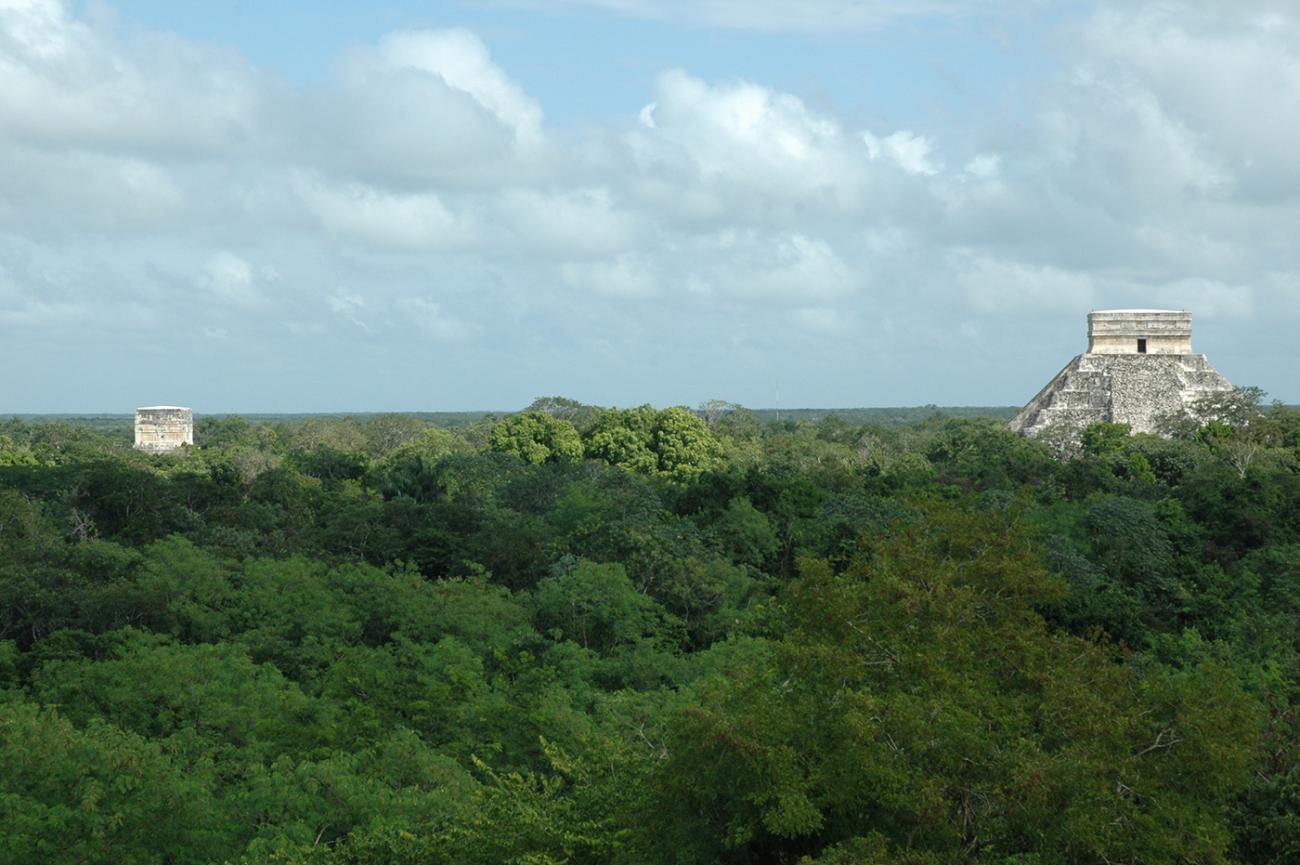
El Caracol or Observatory: So called because of a spiral staircase inside, it has also been named The Observatory, since it is possible that this building, round and erected on two rectangular platforms with different orientation, has served to set astronomical observations. It should be noted that its exterior facade is adorned with masks and human figures surrounded by feathers. Its present appearance is the result of at least six remodeling works. Several constructions were added on the south side, including cisterns, a steam bath and an arch over the sacbe.

Grupo de Las Monjas
This group presents an architecture associated with the Puuc and Chenes architectural styles, which distinguishes it from the Main Plaza, where the buildings are constructed in a style known as Maya-Toltec. The buildings that compose the group are the House of the Nuns, the Annex of the Nuns, the…
Grupo de Las Monjas


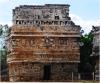



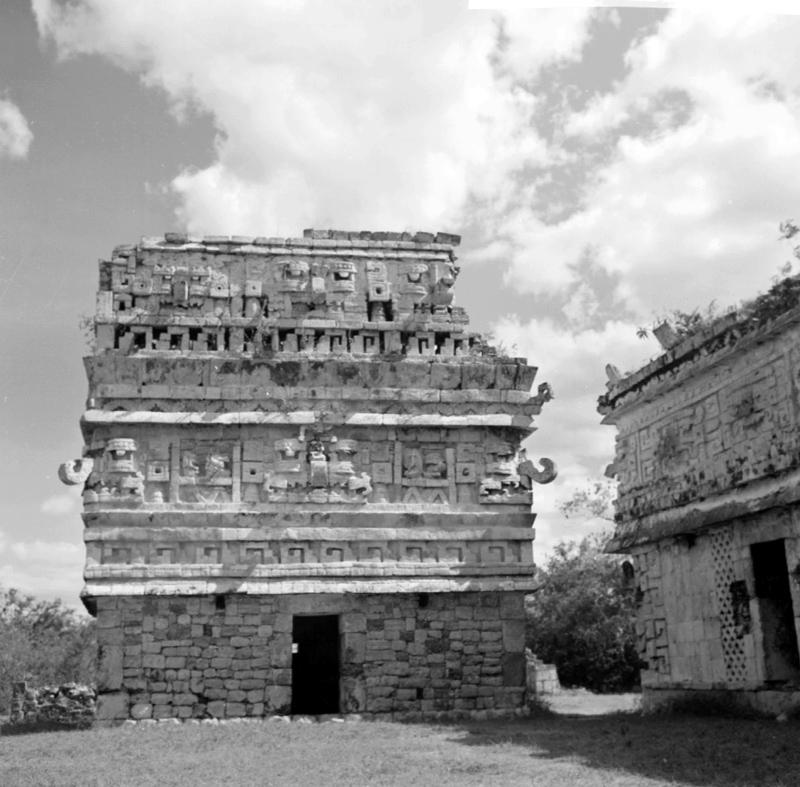
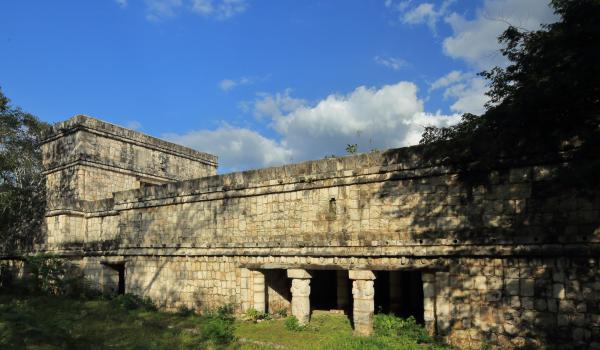
This group presents an architecture associated with the Puuc and Chenes architectural styles, which distinguishes it from the Main Plaza, where the buildings are constructed in a style known as Maya-Toltec. The buildings that compose the group are the House of the Nuns, the Annex of the Nuns, the Church and a Ball Court that has not been archaeologically intervened. Mat designs, hieroglyphic texts and a two-headed jaguar throne located on the side of the main staircase are associated with this building.
The Church: It is a small building that stands out for the elaborate Puuc style decoration of its façade, with geometric elements and representations of gods.
Annex of Las Monjas: The construction is part of the original building of Las Monjas. On the façade there is a large number of masks representing the god Chaac. The door with an inscription is reminiscent of the Chenes style. This complex presents an architecture associated with the Puuc and Chenes architectural styles, a particularity that distinguishes it from the Main Plaza where the buildings are built in the Maya-Toltec style.
Chichén Viejo Grupo de la Serie Inicial
This group is located to the south of the ancient city in what is known as Chichén Viejo, the group is a residential complex where the elite of Chichén Itzá lived, it is made up of living spaces and small temples. The Temple of the Phalluses, the Temple of the Snails, the Temple of the Monkeys and…
Chichén Viejo Grupo de la Serie Inicial


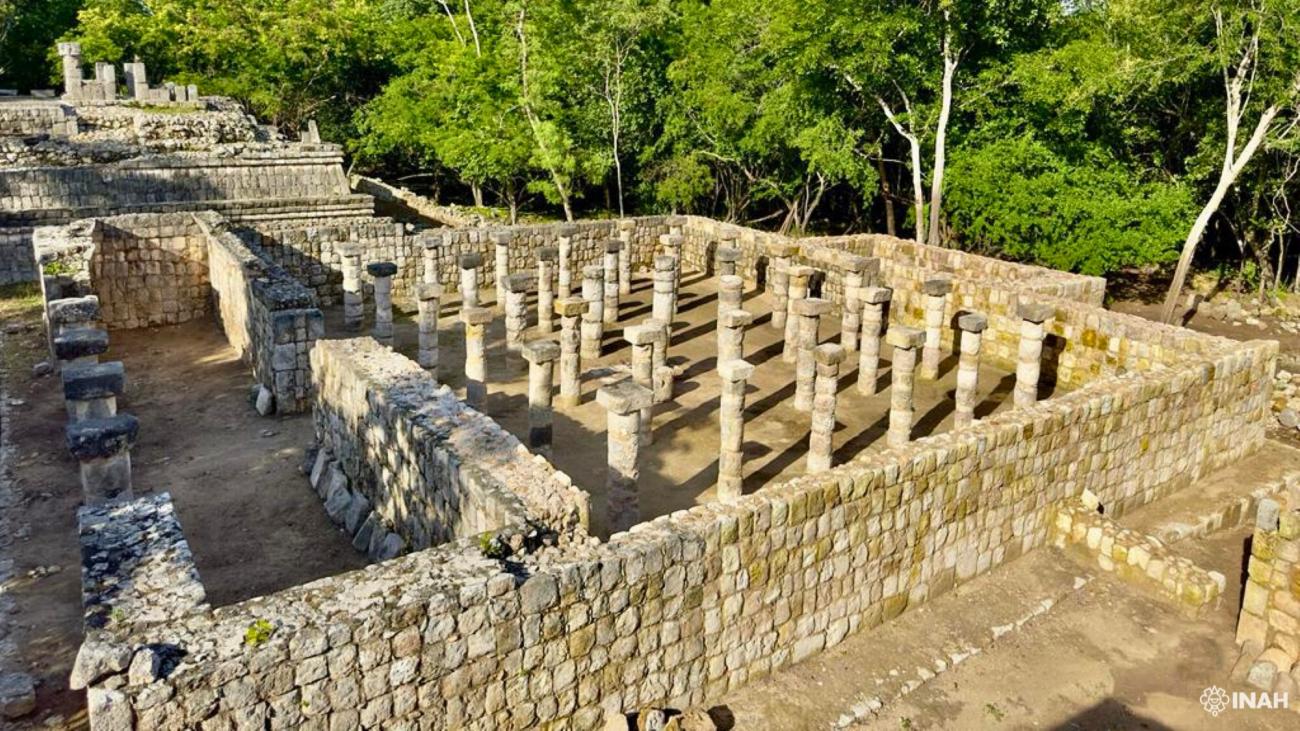
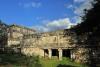


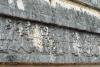
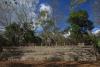
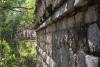
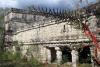
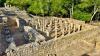
This group is located to the south of the ancient city in what is known as Chichén Viejo, the group is a residential complex where the elite of Chichén Itzá lived, it is made up of living spaces and small temples. The Temple of the Phalluses, the Temple of the Snails, the Temple of the Monkeys and the Temple of the Initial Series are distinguished, from which the group takes its name, given that in this space was located a lintel with hieroglyphic writing written in the long count used by the Mayas.
Temple of the Initial Series: This construction presents a frontal stairway in its west side, which is related to a sacrificial stone, in its superior part, and with a Chac Mool, in the inferior one. On a platform that was part of a first structure, a building with two bodies was built, which is currently known as Temple of the Initial Series. This construction presents a frontal stairway on its west side, which is related to a sacrificial stone, in its upper part, and to a Chac Mool, in the lower part. In the superior area of the structure appear two atlantes that make the function of jambs of entrance to the temple and sustain a lintel that has inscribed the date July 30, 878 A.D.
Reservations are required at the Chichén Itzá Archaeological Zone ticket office. Admission will be in groups of a maximum of 50 people, accompanied by INAH personnel and a guide.
Fridays and Saturdays from 09:00 to 11:30 h and from 12:00 to 14:30 h








Contact
- Dirección de la Zona Arqueológica y Museo de SitioMaría Guadalupe Espinosa Rodríguezguadalupe_espinosa@inah.gob.mx+52 (985) 851 0137